Showing posts with label control. Show all posts

Wednesday, September 17, 2025

Unknown Depths of Anger

    I once knew a man who dearly loved his wife & sons, and loved to take them skiing, hiking, canoeing, fishing, camping. My family and I gladly did all of these with them. He was a very honest, hard-working, sincere, 'straight-as-an-arrow,' 'by-the-book' fellow. He'd happily chat except about anything to do with religion or spirituality. These were strictly off limits, and we never learned why. All his hard work seemed to pay off when he landed a strikingly lucrative job as one of six in-house lawyers for a multinational lumber company. But within a month or so, his boss asked him to sign off on a document that our friend knew was shady, so he refused to sign. This immediately got him fired.
    His
 whole world collapsed. He abandoned his family, changed his name, joined a religious cult, and moved to Europe. When his existing worldview crumbled, he 'flipped' to its opposite.  


David Whyte’s poem “Anger”:

    "ANGER is the deepest form of care, for another, for the world, for the self, for a life, for the body, for a family and for all our ideals, all vulnerable and all, possibly about to be hurt. Stripped of physical imprisonment and violent reaction, anger points toward the purest form of compassion, the internal living flame of anger always illuminates what we belong to, what we wish to protect and what we are willing to hazard ourselves for. What we usually call anger is only what is left of its essence when it reaches the lost surface of our mind or our body’s incapacity to hold it, or the limits of our understanding. What we name as anger is actually only the incoherent physical incapacity to sustain this deep form of care in our outer daily life; the unwillingness to be large enough and generous enough to hold what we love helplessly in our bodies or our mind with the clarity and breadth of our whole being.
    What we have named as anger on the surface is the violent outer response to our own inner powerlessness, a powerlessness connected to such a profound sense of rawness and care that it can find no proper outer body or identity or voice, or way of life to hold it. What we call anger is often simply the unwillingness to live the full measure of our fears or of our not knowing, in the face of our love for a wife, in the depth of our caring for a son, in our wanting the best, in the face of simply being alive and loving those with whom we live.
    Our anger breaks to the surface most often through our feeling there is something profoundly wrong with this powerlessness and vulnerability; anger too often finds its voice strangely, through our incoherence and through our inability to speak, but anger in its pure state is the measure of the way we are implicated in the world and made vulnerable through love in all its specifics: a daughter, a house, a family, an enterprise, a land or a colleague. 
    Anger turns to violence and violent speech when the mind refuses to countenance the vulnerability of the body in its love for all these outer things - we are often abused or have been abused by those who love us but have no vehicle to carry its understanding, who have no outer emblems of their inner care or even their own wanting to be wanted. Lacking any outer vehicle for the expression of this inner rawness they are simply overwhelmed by the elemental nature of love’s vulnerability. In their helplessness they turn their violence on the very people who are the outer representation of this inner lack of control.
    But anger truly felt at its center is the essential living flame of being fully alive and fully here, it is a quality to be followed to its source, to be prized, to be understood fully at the very spring of its birth: it is an invitation to find a way to bring that source fully into the world through making the mind clearer and more generous, the heart more compassionate and the body larger and strong enough to hold it. What we call anger on the surface only serves to define its true underlying quality by being a complete and absolute mirror-opposite of its true internal essence."


      I emailed Whyte's poem above, as well as the link to his imho wonderful interview (bottom of this page) to a relative who is on a spiritual path, as well as an old friend whose dogmatic belief is that we live in a cruel meaningless mechanical Cosmos, and who has, on a couple of previous occasions, become very angry when I suggested otherwise. I had (naively) hoped that Whyte's nuanced, compassionate understanding of anger might soften my friend's rigid armor.

    My relative's response started like this:
    "I watched 5 minutes of Whyte and stopped.
     Not because it's useless but because it resonates so well and connects with so many thinking points that I had to put some down before resuming. ..."

    My friend's response started like this: 
    "I have read the "poem". This guy, Whyte, has trouble with language. For example, when is a poem, a poem? And when is anger, anger? He keeps ..
." 
    
My friend made no mention of the interview - probably too angry to notice the link, or the mention of it in the subject heading of the email. Coincidentally, David Whyte is a well-known, highly-respected poet, with multiple published books, so the "trouble" may not be in Whyte's use of "language."

    Whyte's interview skillfully addresses anger about aspects of life we cannot control, and much more:

    Interviewer: “… the intersection between powerlessness and anger. When we’re made to make contact with that sense of helplessness or powerlessness, our immediate response is rage, anger. Can you unpack that?”

    David Whyte (DW): “Well you can immediately see its actual practical physical evolutionary necessity, in rage and physical defense in people you love. So the inability to actually be able to do something about something that doesn’t involve physical defense (invokes frustration & anger). What's actually needed involves another kind of deeper cradling, or holding, which our physical bodies are unable to do. We have to be able to hold another person in our heart and our mind. And that heart energy is often what we feel lies below the horizon of our inner line of resistance. So opening the heart is always a very powerful path for a human being to take. 
    Albert Camus, the great French writer & philosopher, had a beautiful invitation. It was just one simple line, ‘live to the point of tears.’ This is not an invitation to maudlin sentimentality. This is asking you to feel things, right to their Essence. If you just have an edge of dread about something, then feel that dread more, don’t resist it. Get to the center of it until it starts to change into something else. 
    The Greeks had this beautiful word, which we don’t have in modern English, which is, ‘enantiodromia,’ and it means the ability of something, once it becomes its absolute essential self, to start changing into something completely different, and quite often its complete opposite. Which is why immovability always changes into incredible fluidity, once you’ve got through that. So to be able to feel things until they actually start to have a life of their own, and start to mature 
… 
    This
 is a received understanding in psychology, that parts of us when they’re traumatized, stay stone-like inside you for good reason, and refuse to grow older, until that trauma has been resolved. The traumatized part doesn’t want to move on until it’s healed. And maybe it would be very destructive if it moved on prematurely. So finding the parts of you that are stuck – is a wonderful thing actually. It’s not a pejorative thing. And to feel the stuckness even more, to get right to the heart of your stuckness, your inability to say it, and then you start saying it, it’s quite remarkable really.”

    Interviewer: “It’s brutal though. I find that there’s something beautiful and brutal about it.”

    DW: “This is why in all real Warrior Traditions, there’s always been a parallel discipline of poetry. You look at Samurai, the Japanese tradition, Chinese tradition, Indian tradition, and in the West we have the first World War poets like Sassoon. Poetry is the way in for anyone at all, man or woman or anything in between. But for men, it’s a real doorway. We all instinctively understand what poetry represents. Even people who’ve hardly read a line of poetry in their life, will come away from a football game saying, ‘it was sheer poetry, that touchdown!’ We instinctively understand about the verve and vitality and mutability and movability and tidal forces of the world, if you can capture these in speech (poetry). And if you can capture these in movement on a football field, why couldn’t you catch it in your own voice? So I would say, besides the practical activity of something that concerns all heterosexual young men, which is getting into real conversations with young women, I would recommend poetry rather than a Maserati.

    It can be comforting for a young man to know that under this inability to speak my emotions, underneath this inability to feel what I feel, underneath this inability to bring those two poles together, feelings, emotions and articulation, there’s something really quite astonishing waiting for me. The great German speaking-poet Rilke said, ‘Stretch your well-disciplined strength between two opposing poles, because inside human beings, is where God learns.’” 
    David Whyte "Facing The Unknown And Finding Meaning" https://www.youtube.com/watch?v=or44UlIKQuE SUPERB interview imho - HIGHLY RECOMMENDED!

David Whyte - "Facing The Unknown And Finding Meaning"


Friday, November 24, 2023

What is Trustworthy?

    "Einstein was asked what he thought the most important question was that a human being needed to answer. His reply was, ‘Is the universe a friendly place or not?’
    Our answer to that question is the cornerstone on which many of our values & beliefs inevitably rest. If we believe that the universe is unfriendly & that our very souls are in danger, peace will be elusive at best."
    Joan Borysenko. “Fire in the Soul. A New Psychology of Spiritual Optimism.” Warner Books, 1993.

    Many years later, one of the world's foremost PTSD experts expanded on the same topic:
    “If you feel safe & loved, your brain (is) specialized in exploration, play, & cooperation; if you are frightened & unwanted, it (is) specialized in managing feelings of fear & abandonment.
"
    Bessel Van Der Kolk. “The Body Keeps the Score. Brain, Mind, and Body in the Healing of Trauma.” Penguin Books, 2015.

    "The Great Way is not difficult
     for those who have no preferences..."
Sengstan

    We all have many, perfectly harmless preferences, like enjoying one flavor of ice cream more than another.
    But why does not getting what we want so powerfully grab our attention? Perhaps it's because many of us live under the (mostly subconscious) assumption that survival & safety depends entirely on our ability to control our environment. We live in fear that failing this, will quickly bring chaos, sickness, starvation & death.
No wonder we're triggered every time life appears indifferent to our personal preferences.
    Yet realistically, how often does our every wish (preference) come true? Rarely, & then only briefly. So most of us spend our lives striving mightily against 
reason & reality by trying to capture & sustain personal preferences. We cling to our preferences like drowning people cling to bits of wood floating by. This is how we create most of our suffering, and it's completely unnecessary!

    “Life rarely unfolds exactly as we want it to. And if we stop and think about it, that makes perfect sense. The scope of life is universal, and the fact that we are not actually in control of life’s events should be self-evident. The universe has been around for 13.8 billion years, and the processes that determine the flow of life around us did not begin when we were born, nor will they end when we die. What manifests in front of us at any given moment is actually something truly extraordinary – it is the end result of all the forces that have been interacting together for billions of years. We are not responsible for even the tiniest fraction of what is manifesting around us. Nonetheless, we walk around constantly trying to control and determine what will happen in our lives. No wonder there’s so much tension, anxiety & fear. Each of us actually believes that things should be the way we want them, instead of being the natural result of all the forces of creation.
    Every day, we give precedence to our mind’s thoughts over the reality unfolding before us. We regularly say things like, ‘It better not rain today because I’m going camping’ or ‘I better get that raise because I really need the money.’ Notice that these bold claims about what should and shouldn’t be happening are not based on scientific evidence; they’re based solely on personal preferences made up in our minds. Without realizing it, we do this with everything in our lives – it’s as though we actually believe that the world around us is supposed to manifest in accordance to our own likes & dislikes. If it doesn’t, surely something is very wrong. This is an extremely difficult way to live, and it is the reason we feel that we are always struggling with life.
    The question is, does it have to be this way? There is so much evidence that life does quite well on its own. The planets stay in orbit, tiny seeds grow into giant trees, weather patterns have kept forests across the globe watered for millions of years, and a single fertilized cell grows into a beautiful baby. We are not doing any of these things as conscious acts of will; they are all being done by the incomprehensible perfection of life itself. All these amazing events, and countless more, are being carried out by forces of life that have been around for billions of years – the very same forces of life that we are consciously pitting our will against on a daily basis. If natural unfolding of the process of life can create and take care of the entire universe, is it really reasonable for us to assume that nothing good will happen unless we force it to?
    There must be another, more sane way to approach life. For example, what would happen if we respected the flow of life and used our free will to participate in what’s unfolding, instead of fighting it?
”
    Michael A. Singer “The Surrender Experiment. My Journey into Life’s Perfection,” Harmony, 2015.

    A few more insights from Singer - a meditator & businessman, who maintained a very deep meditation & yoga practice WHILE creating & running highly successful companies:

    “the personal mind (with it’s neurotic chatter) always returned once I got up (from sitting Zen meditation) and became active. … one day in a flash of realization it dawned on me that perhaps I’d been going about this in the wrong way. Instead of trying to free myself by constantly quieting the mind, perhaps I should be asking why the mind is so active. What is the motivation behind all the mental chatter? If the motivation were to be removed, the struggle would be over.
    This realization opened the door for an entirely new & exciting dimension to my practices. As I explored it inwardly, the first thing I noticed was that most of the mental activity revolved around my likes & dislikes. If my mind had a preference toward or against something, it actively talked about it. … it was these mental preferences that were creating much of the ongoing dialogue about how to control everything in my life. In a bold attempt to free myself from all that, I decided to just stop listening to all the chatter about my personal preferences, and instead, start the willful practice of accepting what the flow of life was presenting me.
    I would let go of my preferences and let life be in charge. … If life brought events in front of me, I would treat them as if they came to take me beyond myself. If my personal self complained, I would use each opportunity to simply let him go and surrender to what life was presenting me. This was the birth of what I came to call ‘the surrender experiment.’
    Surrender – what an amazingly powerful word. It often engenders the thought of weakness & cowardice. In my case, it required all the strength I had to be brave enough to follow the invisible into the unknown."

     Singer's experiment was very successful. His suggestion?

    “Do whatever is put in front of you with all your heart & soul without regard for personal results. Do the work as though it were given to you by the universe itself – because it was.”
    Michael A. Singer “The Surrender Experiment. My Journey into Life’s Perfection,” Harmony, 2015.

    It's understandable, especially if we've had a rough childhood & a harsh life in general, for us to be flailing frantically for control. And yes, it's almost impossible to teach more effective swimming techniques to someone WHILE they're drowning. Nevertheless, there ARE MUCH wiser ways of being in the world than remaining trapped, identified with our neuroses.


Thursday, August 31, 2023

One Love

    We all function at 2 very different levels of consciousness (ways of being) on different occasions.
    How often do you recognize this in yourself?
    Why is differentiating between these important?

    Too often, most of us are striving to control our external world – ‘just trying to get by’ – not only in the present, but even in the future or the past! This feels stressful. No matter how well we manage situations, we feel it should have gone better, and there’s a nagging sense of lack or emptiness inside – ‘I can’t get no satisfaction.’ At this level of consciousness, we feel alone & at least somewhat alienated from everyone & everything else in the world. To some extent at least, most of us have been conditioned to perceive the world as uncaring, at times even hostile to us. As a result, this fear-based, survivalist (FBS) level of consciousness / way of being - often referred to as the ‘small self’ (Eckhart Tolle’s ‘pain body’) – dominates our way of being in the world.

    “All of us are prisoners of our early indoctrinations, for it is hard, very nearly impossible, to shake off one’s training.”
Jubal, in ‘Stranger in a Strange Land,’ by Robert Heinlein

    At times, however, you may feel deeply immersed, ‘at one with’ an activity - alone or with one or more people. There’s no thought of yourself, time, or anything outside of this one activity. You, the activity & other participants are a single, pleasantly flowing process, like a wonderful dance or joyous celebration. You feel gratitude, intimacy with everyone & everything. Psychologist Csikszentmihalyi named such common but sporadic, universal human experiences ‘flow.’
    However, when this sense of (‘true self’) Self becomes increasingly dominant in one’s life, spiritual teachers refer to this sense of unity or oneness as ‘Universal Consciousness’ in the process of ‘awakening.’

    Our deeper intelligence tells us that we're profoundly interconnected & interdependent with everyone & everything - AND - science shows that we're only truly happy while intimately engaged with whoever / whatever we're dealing with in each successive present-moment.
Killingsworth MA, Gilbert DT. “A Wandering Mind is an Unhappy Mind.” Science 2010; 330(6006): 932.

    “When we quit thinking (excessively) about
ourselves & our own self-preservation
, we undergo
a truly heroic transformation of consciousness.”
Joseph Campbell

    "… the greatest antidote to insecurity & sense of fear is compassion. It brings one back to the basis of one's inner strength. A truly compassionate person embodies a carefree spirit of fearlessness, born of the freedom from egoistic self-concern."
The Dalai Lama

    How can we tell when we’re in fear-based survivalist (FBS) mode?
    It’s
pretty fast & easy when we learn to focus on & thus refine awareness of our thoughts & feelings. Physically FBS mode feels tight & cold. Mentally / emotionally FBS feels insecure, repetitive, unpleasantly stressful & unsustainable. It’s easy to recognize the re-run of old internal conversations we’ve heard way too many times before: ‘I’m no good at this,’ ‘I can’t handle this,’ ‘When will this be over?’ ‘I hate this,’ ‘Are we there yet?’ ‘If only I could have x, THEN I’d be happy,’ ‘If only I could avoid y, THEN I’d be happy,’ ‘If only z never happened, THEN I’d be happy,’ ‘If only so & so could change, THEN I’d be happy,’ etc, etc.
    Habitually
worrying about ourselves almost non-stop, is simply failing to realize that far from being helpful, it is the cause of most of our unnecessary suffering.
    Even in the worst possible situations – the death by suicide of one’s child or the loss of one’s family, home & all possessions in fires or floods – the most healing thing people who’ve sustained such unimaginable losses can possibly do, is to help others who’ve just suffered these same losses. This is the all-important shift from preoccupation with self to concern for others.

    It’s impossible to be happy when we fail to be authentic / true to our Self, just as it’s impossible for a fish to be happy flopping about on dry land; or for a healthy eagle to remain stuck in a small cage. It’s largely up to us WHETHER we remain stuck in the rat race – OR – be authentic to our true nature. Re-discovering who we truly are is primarily an intuitive journey, not something we can think our way to. Thinking is based on theories & models of reality. Who we truly are must be directly experienced, in the moment
.
    Gangaji
skillfully points us to directly experience our true nature:

    “I really try to direct people into just discovering there is a direct experience and then there is a narrative about that direct experience. Because we’re so attuned to the narrative (our internal conversations, opinions, judgments), we often follow the narrative as if it were reality, as if it were the direct experience. (BUT our narrative is based on our past experiences & how these have conditioned us to react. So, as Anais Nin has keenly observed, “We don't see things as they are, we see them as we are.” ie we see & react to memories from our past, triggered by the present, rather than being able to directly experience & thus respond appropriately, to what we encounter right here & now.)  
    So even a superficial experience like feeling anger, or irritation not even anger. You feel irritation, we have a narrative about that. We’re righteous in our irritation because somebody cut me off on the freeway. Or, ‘Oh, I shouldn’t feel that way, I should let them do what they have to do. I shouldn’t feel this.’ And we get caught up in our internal conversation and we don’t get to experience the depth of what is here
.
    Even if it starts as something superficial, like an irritation, in the willingness to experience that without the narrative about that; without good or bad judgment; just to for a moment be absolutely, completely irritated. And without a narrative, irritation can’t last. But it can reveal something deeper – maybe it’s true anger, maybe fear, maybe bliss, and finally, maybe, this radiant, unspeakable, indefinable presence of your own being.
”

    Gangaji interview: https://www.youtube.com/watch?v=cSVtlpsN58k - POWERFUL 81-year-old female spiritual teacher

    "Someday, after mastering the winds, the waves, the tides and gravity, we shall harness for God the energies of love, and then, for a second time in the history of the world, man will have discovered fire." Pierre Teilhard de Chardin SJ


Saturday, February 12, 2022

Beyond Even the Fear of Losing Control

     Our usual mindset or operating system is based on our society's (mostly unexamined) assumption that ONLY physical stuff (matter) is real, because we can all see, feel & therefore agree upon it. Most of us have inadequate training & understanding of either science or of metaphysics ("the branch of philosophy that studies the fundamental nature of reality, the first principles of being, identity & change, space & time, causality, necessity, & possibility. ... the nature of consciousness and the relationship between mind & matter ... 'metaphysics' ... literally means "after or behind [the study of] the natural*." wikipedia.org - *"natural" implies physical stuff). Metaphysics, in simple terms, refers to everything OUTSIDE of our tiny "box" of information, which, for some ONLY contains physical "stuff." Though sometimes encouraged to do so, most of us simply can't or won't "think outside the box" because leaving this "comfort zone" of dogmas & other (incorrectly) assumed certainties, requires more bravery, open-mindedness, creativity, & energy than most of us have. So we often need to graduate from the school of hard knocks to crack open our numb skulls & hard hearts. 

         There is a crack, a crack in everything
         That's how the light gets in
                  Leonard Cohen, "Anthem"

         "Grant me the serenity to accept the things I cannot change;
          courage to change the things I can;
          and wisdom to know the difference."
     Reinhold Niebuhr's "Serenity Prayer" - later adopted & popularized by Alcoholics Anonymous & other 12-step programs - is profoundly wise, AND YET many of us have to "hit rock bottom"
before we take it seriously. Our society frantically chases after short-term pleasures while values such as serenity & wisdom are forgotten. Few can define these terms, never mind live them.

     We're like a small sailboat out in the middle of the ocean.
    
Religion was meant to be our sailboat's ballast, allowing us to maintain a steady course, without capsizing in storms. As with other large businesses that mass-produce heavily-processed stuff eg junk-foods, organized religions continue to devolve from an idealistic mission eg optimal nutrition, down to maximizing "market share," mission be damned.
     Scientism. The
remarkable impact of scientific innovations and the resultant readily-available cheap consumer items easily converted many from anemic religions to true-believers in "scientism" - the pseudo-religious belief in "stuff," containing the most toxic elements of theistic religion (dogmatism & exclusivism), but none of the most intelligent, vitally important elements of science.

     A few words about science. Most (including "hard science only" fans) assume that "science" refers only to "natural sciences" (biology, chemistry & physics) which deal directly with matter/energy. Here, only physical matter / energy is studied, because only these can be (readily) measured, so that others ('third parties') can repeat the experiment, 'objectively' proving or 'refuting' the validity of the measurements.
     Seldom
recognized by the public, though critically important, is that the object of scientific interest typically must to be removed / isolated from its natural surroundings (taken out of context***) & brought into a sterile laboratory so that the study can focus ONLY on the experimental object.
    
Rarely (never?) mentioned now, though this was a standard disclaimer at the end of every scientific paper until ~40 years ago, went something like, 'the results of the present study are valid only under the described experimental conditions, and conclusions cannot be made beyond the present
experimental conditions.' TWO important ramifications of this disclaimer:
     1)
If another lab's
methods deviate at all from the original lab's, they should get different results, and so it cannot disprove the original lab's results.
     2)
The process of removing the object
from its native environment for scientific study, unavoidably causes varying degrees of damage. Further damage then occurs as the isolated object is exposed to a completely foreign, often inhospitable lab ('in vitro') environment. Still further damage occurs when the object is subjected to experimental stimuli - the "experimental conditions".
     These
represent BOTH a strength, AND a limitation of the scientific method. The strength: isolation allows scientists to study the object of interest, with minimal contamination by other objects, be it from the objects natural environment, or the lab itself. The limitation: given how
even a slight difference in methodology (eg lower temperature) between labs changes the results of the experiment, how closely can we expect our lab findings of the profoundly damaged, isolated object compared to when it's undisturbed, functioning harmoniously with its natural environment? Hidden here also a key materialist dogma - the belief in the primacy of matter, which here implies that we should be able to build anything, including human life itself, from basic building blocks. Critics correctly call this clear limitation & increasingly questionable dogma, "reductionist" - analyzing & describing a complex phenomenon in terms of its simple or fundamental constituents. Varying degrees of isolation, manipulation & simplification are necessary, regular, normal aspects of science BUT this, often radically simplified model, can only provide hints about complex reality. *** It's very useful to remember that patients who suffer a stroke of the right hemisphere, by loosing context, are profoundly handicapped, vs the left hemisphere (loosing narrowly-focused task-orientation) are, despite also loosing the ability to speak & important motor skills, are far less handicapped.
    Below
, even more potential surprises about real science:

      Thomas
Kuhn's classic, 'The Structure of Scientific Revolutions' intelligently describes scientific progress. "... science changes, adapts, and specializes to fit the times. It does not work toward some absolute 'truth,' but merely continues its work of studying and understanding the world.
     Many
people have the idea that science progresses in a linear fashion—a straightforward march from ignorance to knowledge. If that were true, then there would be no such thing as scientific revolutions; old ideas would never need to be overturned, only built upon.
     However
, not only do scientific revolutions happen, they follow a specific pattern. The Structure of Scientific Revolutions lays out this pattern clearly and labels each part of it. The parts are:
          1) Normal
science: The process of adding to existing knowledge through experiments and study.
          2) Puzzle-solving: Finding and fixing discrepancies in science as we currently understand it.
          3) Paradigm: ... a paradigm could be seen as a perfect example of an idea, which can be expanded into the framework of a whole field of scientific understanding. For example, think about the evolution of humans from a more ape-like ancestor. Using that paradigm, evolutionary biologists form the framework for all of their studies.
          4) Anomaly: Someone finds a discrepancy between the current paradigm and experimental results.
          5) Crisis: The discrepancy can’t be resolved. Scientists loyal to the current paradigm try to dismiss it, while others try to show that the current paradigm is wrong.
          6) Revolution: The old paradigm is overthrown by new information, and eventually a new one takes its place—a 'paradigm shift.' There have been many such revolutions in history that completely changed the way people understood and approached the world."
https://www.shortform.com/summary/the-structure-of-scientific-revolutions-summary-thomas-kuhn?gclid=Cj0KCQiA0p2QBhDvARIsAACSOOMmoBYMECSzkKRKJzS7FE-4GF1pWw0Gpm694tLTYiajFjmBTBdZejkaAh2FEALw_wcB

     It's "only human" to resist change, especially when one's ego, prestige, livelihood & (false) identity depend on defending outdated ideas & ways of thinking. However, when mounting new evidence is ignored, suppressed, ridiculed & shamed, it's because of dishonesty & incompetence, typical of religious cults, but has no place in science, nor meaningful religions.

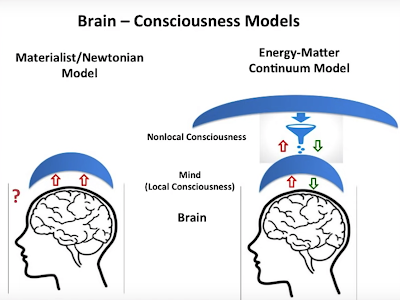
"Models of Consciousness: Determinants of Our Lived Reality
     If you believe in a materialist model that considers consciousness beyond the human waking, dream and sleep states to be abnormal or nonexistent, this will limit your sense of interconnection. But if your model includes a continuum of consciousness within everything, the feeling of connection inherent in this model will naturally generate compassionate action: you understand that what happens to others also happens to you.
     Regardless of which model you accept, a key question is whether you are open to modifying your understanding based on emerging evidence regarding the nature of consciousness? Here is how the astrophysicist Bernard Haisch explains the strong grip of the medical model on modern science and our culture:
'Modern Western science regards consciousness as an epiphenomenon that cannot be anything but a byproduct of the neurology and biochemistry of the brain. While this perspective is viewed within modern science as a fact, it is in reality far stronger than a mere fact: it is a dogma. Facts can be overturned by evidence, whereas dogma is impervious to mere evidence.'
    
Bernard Haisch quoted in: David J. Chalmers. "The Conscious Mind. In Search of a Fundamental Theory."1997, p53

     Consider whether you are open to expanding your existing model of consciousness. As our model of consciousness expands, our experience of connection with everyone and everything around us expands as well. And this, in turn, can lead to an increased capacity for compassion and for actions by which we can heal ourselves and our planet."
     Marjorie
Woollacott PhD neuroscientist https://www.huffpost.com/entry/our-models-of-consciousness-how-they-shape-our-reality_b_59270990e4b0aa7207986b94

     Consider the story of this, now middle-aged, lady who had a near death experience (NDE) at 4 years of age. For much of her life, she only remembered the dark, scary components of her NDE, causing her to fear the dark & falling asleep. This terror was triggered when as an adult she was advised to have a general anesthesia (GA) for an operation. A brief excerpt: 
     “And suddenly it terrified me, with hot & cold shivers going through my body, that in essence it meant giving up control of one’s own consciousness. For about a quarter of an hour I was just going through the feeling of the essence of that loss of control, and tears washed down my face when I had to think about it. That this is the essence of dying, to just let go, to dive down without any ground under your feet. That this is the step out of control, like in death."
     During the GA, she finally remembered all the positive bright, loving, safe, welcoming components of her NDE, and lost her fear of the darkness, sleep, general anesthetic & death. Sometimes, when we lack the courage to accept that which we fear, life overwhelms our childish ego's feeble illusion of control, allowing us finally to see the reality that is here, yet beyond our simplistic materialistic ideas about reality.
    "If we let go of the rational control over our own consciousness, we can get somewhere that forms us and that also forms the universe. I acknowledge that this is, in my opinion, a very important state of mind, a very important process for us all.”

     See Marjorie Woollacott's imho excellent 65min lecture on NDEs, Meditation & Consciousness: https://www.youtube.com/watch?v=BGi39C5Ysk8&list=PLZwmf_5L38HgyTfPnr3hohBbP_-okYhGX&index=1

     We all know that fear triggers our strong survival instinct to control (fight, flight, freeze). However, as the Serenity Prayer (top of the page) suggests, this drive to control is only appropriate & helpful if the situation can be controlled. 
     When we transcend fear - which is often a hard-earned skill, then acceptance, love & connection with a profoundly better, infinitely greater reality opens up.
 

Marjorie Woollacott PhD


Friday, November 8, 2019

Control, Chaos and our Hemispheres

     Clinicians love to cure - definitively fix - the sick, the broken. And many of us, at least when we feel broken, want to be fixed-up once & for all! We all dearly love 'agency,' the sense of control, the ability to reach out, grab & hold onto what we want, and push away what we don't want.
     At some level, we realize that this idea of perfect control over our life & environment is wishful thinking, based on an a childishly unrealistic, simplistic, mechanistic, reductionist model. Life's complexity extends well beyond our comprehension, never mind control.
    However
, we dread the idea of being overwhelmed by chaos - being helplessly out of control as our world crumbles around us. So to create some sense of agency, we tend to restrict our attention to manipulating whatever we can. But with this narrowed focus, many of us forget about or even become averse to the big picture that includes the most meaningful dimensions of life that cannot be controlled or even be put into words!
    Our
current Western society tends to overuse the perspective of our left hemispheres, and at best ignores, at worse ridicules & actively suppresses the
perspective of our right hemispheres.
    This
lack of balance causes serious conflicts: rigid partisanship (political, religious, ecological, ethnic, racial, gender, economic, and even academic / educational: 'hard' sciences vs 'soft' sciences & arts) instead of harmonious tolerance, balance & collaboration. It seriously impacts the education of even our health-care professionals: http://healthyhealers.blogspot.com/2012/02/control-and-liminality.html
     Extreme positions eg towards control, often produce unintended, undesired results eg chaos.

     Iain McGilchrist spent 20 years researching & documenting the neurological basis & Western cultural rationale for a healthy balance between the two hemispheres, perhaps summarized in Reinhold Niebuhr's 'serenity prayer':
          Grant me the serenity to accept the things I cannot change;
          courage to change the things I can;
          and wisdom to know the difference.

     “Attention is not just receptive, but actively creative of the world we inhabit. How we attend makes all the difference to the world we experience. And nowadays in the West we generally attend in a rather unusual way: governed by the narrowly focused, target-driven left hemisphere of the brain.
     Forget everything you thought you knew about the difference between the hemispheres, because it will be largely wrong. It is not what each hemisphere does – they are both involved in everything – but how it does it, that matters. And the prime difference between the brain hemispheres is the manner in which they attend. For reasons of survival we need one hemisphere (in humans & many animals, the left) to pay narrow attention to detail, to grab hold of things we need, while the other, the right, keeps an eye out for everything else. The result is that one hemisphere is good at utilizing the world, the other better at understanding it.
     Absent, present, detached, engaged, alienated, empathic, broad or narrow, sustained or piecemeal, attention has the power to alter whatever it meets. The play of attention can both create and destroy, but it never leaves its object unchanged. How you attend to something – or don’t attend to it – matters a very great deal.
     Because of the way we prioritise the left hemisphere’s take on the world, we have ceased to appreciate the meaning of continuity & flow, instead prioritising discrete chunks of experience we call things. This has serious consequences for how we see our selves as human beings and our relationship with the wider world. … the world in which we live in the West is shaped by a set of beliefs about reality which we know from experience, and feel intuitively, to be almost certainly false. Though the consequences of this are widely deplored, we seem strangely powerless to resist it. We are as if in a trance, whistling a happy tune as we sleepwalk towards the abyss."
     Iain McGilchrist. “The Master and his Emissary. The Divided Brain and the Making of the Western World.” Yale University Press, 2019. (An exceptionally worthwhile read IMHO)

     “It’s just not compatible with the left hemisphere’s view that there could be anything wrong with itself. It has a polished, perfectionist view of what it’s doing. It’s therefore very unwilling to accept the contrary argument. As a society I would say, I believe we exemplify this mentality in our world. 
     In a nice piece of research ... they sent questionnaires to over two thousand executives to see how much they knew about their own industries. Managers in the advertising industry were 90% confident they were correct, but were actually wrong 61% of the time; people in IT 95% confident they were correct, only 20% were right; 99% of them overestimated their success. This is the world we’re now living in. 
     Now how did we get trapped in this worldview of the left hemisphere, which is that of the static, the fixed, the certain, the isolated, in competition with others, a detached, unempathic, unflowing world, which has only one value – that of utility? As opposed to a world in which things are seen as seamlessly interconnected, flowing, never certain, constantly changing, but with which we have a relationship of care. 
     How did we get into this trap? I think there are briefly a few reasons: one is that it gives us power, it makes us powerful, and that is hugely seductive. This is the hemisphere about getting. The left hemisphere controls the right hand with which we grasp; it controls the bits of language (not all of language) the bits with which we define things and pin them down, and say we’ve grasped them – so it’s the grasping part us. That makes us powerful but it’s version of the world is also extremely simple. It’s that it’s made out of bits which can be understood, and then we’ve got there. And all the bits that don’t fit with that are sheared off from the model. And so it’s possible at the end of the day to go, ‘I’ve explained everything,’ because actually you’ve only explained the things you’ve allowed into your model. Another thing is that it’s what I call ‘the Berlusconi of the brain,’ because it’s the one that controls the media. It’s the one that actually does the talking and constructs the arguments, so it’s a piece of cake for it to make its points, whereas it’s quite difficult for the right hemisphere to express things that are subtle, often contradictory and implicit. And I think the fourth reason, at the moment, why we are trapped in this is because we’ve evolved a world out there which reflects the left hemisphere’s world inside. So all around us we have the rigid, lifeless, fixed, represented world which is that of the left hemisphere.”
       Iain McGilchrist @ Schumacher College: Things Are Not What They Seem
https://www.youtube.com/watch?v=oXiHStLfjP0
 
      “… we know intuitively that there is a dimension of ourselves and of nature which eludes us because it is too close, too general, and too all-embracing to be singled out as a particular object. This dimension is the ground of all the astonishing forms and experiences of which we are aware. Because we are aware, it cannot be unconscious, although we are not conscious of it – as an external thing. Thus we can give it a name but cannot make any definitive statement about it … 
     Our only way of apprehending it is by watching the processes and patterns of nature, and by the meditative discipline of allowing our minds to become quiet, so as to have vivid awareness of ‘what is’ without verbal comment.

     … seen as a whole, the universe is a harmony or symbiosis of patterns which cannot exist without each other. However, when it is looked at section by section we find conflict.
                       ‘for the world is a shen vessel 
                        and cannot be forced.’
     ‘Shen’ presents problems for the translator... I take it to mean that innate intelligence (or li) of each organism in particular, and of the universe as a whole, which is beyond the reach of calculation."

       Alan Watts. “Tao. The Watercourse Way.” Pantheon Books, 1975.

'Shen'