A precious key pearl I've picked up along the way:
"The Great Way is not difficult for those who haveno preferences..." Sengstan
It's natural, universal & harmless to have mild preferences eg to want chocolate more than vanilla ice cream, or medium-roast more than dark-roast coffee. IF however your world falls apart - even briefly - when you can't get what you prefer, then you are creating UNNECESSARY SUFFERING for yourself & those around you. And most of us take our meaningless preferences way too seriously!
A MAJOR reason for this is that, in lock-step with our current Western society, we're very left-hemisphere dominant - totally dependent oncontrolling the external environment. The fact that we have minimal control over the most aspects of life, perfectionism in general, but especially over the most important, most meaningful aspects of life, is frustratingly unattainable.
Most of us have no idea how powerfully our usual way of thinking & living is handicapped by the dominantmaterialist reductionist worldview. We are saturated with, & drowning in it, regardless of whether we consider ourselves spiritual, religious, atheists or undecided. The chronic frustration of desperately wanting 'complete control' manifests as: cynicism, nihilism, impatience, anxiety,depression, angry outbursts, addictions, illness anxiety disorder (hypochondriasis), burnout, thanatophobia (intense fear of death or dying),violence, suicide, etc.
A major brilliant corrective attempt is Iain McGilchrist's book, “The Matter with Things. Our Brains, Our Delusions, and the Unmaking of the World.” Perspectiva Press, 2021. It is a detailed, intelligent, wise attempt to free readers from simplistic, meaningless materialist perspectivemost of us mistake for "science." In my & many others' opinion, this is the most interesting & most valuable bookyou will ever come across. (I bought the relatively-inexpensive Kindle version.) McGilchrist's book IS a long, patient read, but as he says, “Wisdom is always going to be relatively rare and involves a lot of things."
A deeply meaningful, worthwhile spiritual life - is yours, IF YOU'RE READY to immerse yourself in wisdom.
From the outside, it's so easy to see how others are stuck in a mind-numbingly dreary, repetitive life pattern. However from the inside, all we may feel is security, comfort & even righteous self-satisfaction - even as we glide towards disaster in our waking dream.
A seriously limiting mindset we're mostly not aware of, but are stuck in, is scientific materialism or physicalism - the prevailing, unexamined pseudo-religion of our age, which many believe in as a secular dogma, but which is just a weak idea. It has nevertheless managed to disconnect & alienate many of us from our own true nature, leaving many of us self-centered, cynical, anxious, depressed & hopeless.
“Alienation from nature and the loss of the experience of being part of the living creation is the greatest tragedy of our materialistic era. It is the causative reason for ecological devastation & climate change. Therefore I attribute absolute highest importance to consciousness change.” Albert Hoffman
"Consciousness can & does exist beyond the brain. In the new concept of consciousness, the flow of sensations we call consciousness is as real as energy, frequency, amplitude, phase, and information, and more real than ‘matter.’ The brain is not a material turbine that generates consciousness, and consciousness is not its by-product. Consciousness is a real-world phenomenon. The brain is not its generator, only its receiver & transmitter. Consciousness exists as a real phenomenon in the universe, and this phenomenon is universal; it is ‘one.’ Famed quantum physicist Erwin Schrödinger said that consciousness in the world does not exist in the plural: the overall number of minds in the world is one. In his last years, Carl Jung came to a similar conclusion. The psyche is not a product of the brain and is not located within the skull; it is part of the one-universe: of the unus mundus. In David Bohm’s quantum physics, the roots of consciousness are traced to the deep reality of the cosmos: the implicate order. A number of contemporary scientists, such as Henry Stapp, elaborate this concept. Consciousness, they say, is nonlocal: it is present throughout the universe. The quantum scientists revive an ancient wisdom: We are connected through our participation in the world’s one-consciousness. This is a very different condition from being a separate entity with a separate brain producing a separate consciousness. The new concept of consciousness is more than a theory of consciousness: it is a revolution in our understanding of being." Ervin Laszlohttps://noetic.org/blog/the-consciousness-revolution/
“It is our task to liberate and engage the power of quantum physics’ revelations for the benefit of everyone. The best way to do this is to partake in the most radical, subversive, and powerful form of activism that there is – recognizing & then consciously engaging our own quantum nature.” To help understand the current, very different concepts of how consciousness & the world interrelate, this is imho a pivotally important &intelligently mind-expandingbook: Paul Levy. “Quantum Revelation: A Radical Synthesis of Science and Spirituality.” SelectBooks, 2018.Imho this book is best listened to (eg via Hooplawww.hoopladigital.com ) AND ideally followed along with the hard copy.
"To remain indifferent to the challenges we face is indefensible. If the goal is noble, whether or not it is realized within our lifetime is largely irrelevant. What we must do, therefore, is to strive and persevere, and never give up." The XIV Dalai Lama
One might wonder why a hyper-rational perspective so dominates industrialized societies these days. By hyper-rational I mean unbalanced, very narrow & machine-like, as if human beings were isolated machines, manipulating completely separate, unrelated external mechanical objects, in a totally random, dead, meaningless universe. Seriously?? This is physicalism - the current orthodoxy under which we unknowingly live. But like other dogmatic belief systems, it cries out for open examination & wise correction!
“Materialist or Reductionist Science … has concluded that we are the only sentient beings in an inanimate universe that is without life, meaning, purpose, direction or intelligence. This bleak ‘philosophy’has taken on the power & absolutism of an ideology.” Anne Baring – Awakening to a New Story – The Evolutionary Imperative of Our Time” : https://www.youtube.com/watch?v=hITMBPOwyDY
“Albert Einstein called the intuitive or metaphoric minda sacred gift. He added that the rational mind was a faithful servant. It is paradoxical that in the context of modern life we have begun to worship the servant and defile the divine.” Bob Samples. “The Metaphoric Mind: A Celebration of Creative Consciousness.” Jalmar, 1976.
"Our understanding of knowing is multifaceted and education emphasizes memory, reasoning, learning style, language, intelligence, & on & on. Acknowledging the vast array of distinctions, I want to cut beneath these to claim that with respect to education, consciousness, & culture today, there are two ways of knowing. That is, there are twofundamental ways that the mind works to know the world. There are myriad variations to be sure and certainly plenty of other ways to slice this rhetorically, but the most salient concern today comes down to this. One way we will call categorical. This knows the world through abstraction, through separating it from us, through taking apart to understand. In a sense everything is reduced to parts, to lowest units that are differentiated, named, catalogued. It reaches its apex in metaphor of computer zeroes & ones. Categorical awareness narrows in to focus on detail and seeks precision, objectivity, & presupposes certainty. It simplifies & represents, proceeds linearly & sequentially, and generalizes. Our schooling emphasizes this way of knowing, and for the most part, only this. The other knowing is through contact (experiential) instead of category. Its style is direct, relational, embodied, and recognizes wholes & connections. Awareness through contact enables a broader view, one connected with the world & the body, scanning for changes in the environment. This knowing seeks novelty, picks up implicit meaning & metaphor, is able to read faces & other cues of individualsinstead of simplified, predetermined, and generalized categories. Knowledge through contact is evolving, implicit, & indeterminate since it always exists in relationship to something else and is not ever fully graspable. Iain McGilchrist, drawing from a vast body of neuroscientific and phenomenological data, makes a compelling case that these ways of knowing have neurological substrates corresponding to the anatomically distinct hemispheres of the brain.” Tobin Hart. “The Integrative Mind: Transformative education for a world on fire.” Rowman & Littlefield, 2014.
"Iain McGilchrist, author of, 'The Master and his Emissary. The Divided Brain and the Making of the Western World,' says that we are dominated by this left-hemisphere analytical view, which of course you see going straight into artificial intelligence. And we’ve neglected the right-hemisphere creative, intuitive, holistic side of ourselves. For him, the master hemisphere, in terms of his book’s title, is the right hemisphere, not the left hemisphere, because
• FIRST the right hemispheregives us an idea of the whole, then
• SECONDinformation is sent to the left hemisphere for analytical elaboration, finally
• THIRD it should be sent back to the right hemisphere for a higher level of integration.
So he never says we only need one hemisphere. He says we must create a culture in which these hemispheres are working together and we therefore re-establish our balance." David Lorimerhttps://www.youtube.com/watch?v=Rn00MFFVyIo
"To cut a long story short, it struck me that it was a problem with our thinking ... about things out there that were objects, that didn’t have any kind of embodied reality for us. And that interested me in what's going on in our brains. And when I studied medicine, I was very much inspired by Oliver Sacks and his writings, principally “Awakenings,” an extraordinary book. That book shows that when something goes wrong brain, it affects their whole world. Or something goes wrong with their mind, it affects their body. These things are deeply, closely connected. So I studied medicine, and went off to neurology & psychiatry, which is the area of overlap. It was there that I started to ask myself questions. Why is the brain divided? In medical school, nobody ever said why the brain is divided in two halves. Nobody knew, and nobody even asked the question why. And later, I learned that the two hemispheres have completely different ways of looking at the world. There was a lot of nonsense talked about hemisphere difference that put serious scientists off the topic altogether. I was told, ‘Don’t even touch this topic because it’s career death. It’s pop psychology. It doesn’t have any basis.’ And yet, when one came to look at scholarly research on people who had damage to one or other hemisphere, you could see that they had completely different effects, depending on where it was - the left or the right hemisphere. And that was being overlooked & ignored. People say, ‘Ah there aren’t any really serious differences.’ But I think what they were doing wrong was they were thinking of the brain as a machine. And so they were asking the question you would ask of a machine, ‘What does it do?’ And they said first of all, well the left does reason & language, and the right does emotion & pictures. And then they found that this was completely untrue, because each hemisphere got involved in all those things. But what they didn’t seem to be asking, was the question you would ask a part of a person which is, ‘How, in what waydoes each hemisphere get involved in these things?’ And if you do that, you find that each hemisphere is involved in every single thing that makes up parts of our lives, just with a completely different take on it. That was the difference! To begin with, I couldn’t quite see how staggeringly important this was. Then I realized, the two halves of the brain were attending to the world in two different ways. And we know that when you attend differently, you see different things. There are lots of clever demonstrations, some by Darren Brown the illusionist, and so on, which show that if you’re not expecting to see something, you don’t see it; if you look with a certain kind of attention you see one thing, if you look with another kind of attention, you see something completely different. Quite apart from those clever demonstrations, in our daily life, when we look at things with a certain kind of attention, we find a different kind of world from what is apparently the same world on a different day when we’re attending to it differently. I heard a lecture by John Cutting, whom I considered the most interesting living psychiatrist. He had done what no other physician had been doing, which was looking at what happened after right hemisphere strokes. Everyone was focused on left hemisphere strokes. And they thought well nothing serious happens to somebody with a right hemisphere stroke because they can still use their right hand, and language is usually unimpaired. But actually it turns out that they’re much more seriously impaired, & harder to rehabilitate after a right hemisphere stroke than after a left hemisphere stroke, even though, after a left hemisphere stroke, it’s very probable that you won’t be able to speak or be able to use your right hand. Now that surprises people. But what John was saying is when the left hemisphere is damaged, you see these very obvious results, but when the right hemisphereis damaged, what you don’t immediately see is that their whole experience of the world has changed. And he alerted me to some things in this lecture which rang a bell. He said, the left hemisphere fails to understand implicit meaning – it doesn’t understand metaphor, jokes, irony, sense of humor. It takes things very literally, in a sort of mechanical way. It is less in touch with the body than the right hemisphere, and literally the body image, which is not just a visual image but an image in all senses in the brain of ourselves as embodied beings, is in the right hemisphere. And he was saying also that the general ideas, as it were, get collected abstractly in the left hemisphere, but unique instances, embodied concrete instances of things are better appreciated in the right hemisphere. ... it’s the left hemisphere that does the talking. It’s my left hemisphere now that is speaking to you. And it has set up a kind of language that works well for it. But it’s much harder to convey the meanings & knowledge that the right hemisphere has. And often, when you make something explicit, you utterly change its nature. You see this with sex, you see this with religion, you can see it with jokes, you can see it with poems. And when you disembody something, you utterly change its reality for us and how we relate to it. And when you abstract and generalize something, you’ve completely lost what was unique & special about it. You’re doing a rather paradoxical thing – you’re destroying the thing you’re trying to examine, in the process of examining. And very often, I think, what we as a society have been tending to do in the last 150 years, is increasingly to denature the world by our way of talking about it abstractly, mechanically, reductively. And we have not attended to, because it’s harder to see, what is lost and, what, as it were, the part of us that understands the implicit, knows. Now the implicit is enormous compared with the explicit. The bit that we actually see explicitly, in the center of the focus of our consciousness is minute. It’s conservatively estimated to be much less than 5% of all the stuff that we’re knowing & experiencing, and probably it’s very, very much less than that. So the unconscious mind, which includes the whole of our bodies as well as the other parts of the brain and so forth, is taking in, dealing with, assessing & responding to the world – knowing things as it were, that in our explicit, conscious mind we’ve ruled out, we don’t talk about, and we say we don’t believe in them. So that actually skews the picture of what the world is, who we are, and how we relate." Matter is a Relative Matter with Iain McGilchrist:https://www.youtube.com/watch?v=1kAlwrnpHIs
"There is almost a sensual longing for communion with others who have a large vision. The immense fulfillment of the friendship between those engaged in furthering the evolution of consciousnesshas a quality impossible to describe." Teilhard de Chardin
“It is only with the heart that one can see rightly; what is essential is invisible to the eye.” Antoine de Saint-Exupery, “The Little Prince”
“The most beautiful things in the world cannot be seen or touched, they are felt with the heart.” Antoine de Saint-Exupery, “The Little Prince”
Insights from a present-day, 84-year old mystic & long-time meditator, John Butler: “The more I appreciate the wonder of the world around me, the more I realize my own ignorance & incapacity to understand. And I love the verse from scriptures that says, ‘My ways are higher than your ways, my thoughts than your thoughts,' says the Lord. And also another one that says, ‘The wisdom of man is foolishness to God.’ I suppose that’s why, as we grow in spiritual awareness, what we call knowledge – the answer to questions, also goes through as it were a process of evolution. Nowfaith is really higher knowledge. Lower knowledge is concerned with facts & answers. So we study, we read books, we ask questions, search the internet. Why do these things happen? We try to analyze the different parts. As you stand more at the top of the mountain, somehow these questions rather fall away, and you acquire a deeper understanding – an understanding of wholeness. It’s not so concerned with the bits & pieces of separation. You see the wholeness of things. If you lie on your back and look at the sky, you don’t normally say, ‘Why is this bit of cloud like that? Why isn’t the other bit shaped in the same way? Why are some dark & shadowy? Why are other bits light?’ We’re used to looking at the sky as a whole, aren’t we? And we can see the comings & goings of things, within a greater unity, within a greater harmony. And so, a part of spiritual development is that partial knowledge ie knowledge of different parts, bits of this & bits of that, what you could refer to as ‘name & form,’gets replaced by a higher knowledge, which is called, faith. Now faith is the evidence of things not seen. You don’t see with the eye of flesh. You see with the eye of heart. We’re to understand what can never be explained in terms of ordinary encyclopedic knowledge. Begin to understand the meaning oflove, and of peace, and of freedom. No one can explain what these things are. Yet we all know instinctively what they are. We talk about them every day, like we talk about God. Who really knows what we’re talking about? We may have a sort of inkling, but... Yet there is faith, isn’t there? Faith is a sort of knowing, but a fractured, partial knowing. It’s a knowing that enables one to have faith or trust. And these statements, ‘All things happen for the best, to those that love God.’ It’s really a statement of faith, of higher knowledge, that knows it perhaps instinctively, better than in analytic knowledge. I mean who can ever say, what’s best and what’s worse?” John Butler : https://www.youtube.com/watch?v=J3R_2jOcqSU
"William James more than 100 years ago, speaking of mystical experience said that one of it's characteristics, besides ego dissolution & transcendence of space and time, is its 'noetic quality.' And this was the quality that what you learned, the insights you had, were not merely opinions but were revealed truths. And they have a stickiness & a power that is central to the experience, and it is what allows people to change." Michael Pollan interviewed by Katherine May, "The Future of Hope 4":https://onbeing.org/programs/michael-pollan-and-katherine-may-the-future-of-hope-4/
“When you consider all the saints and prophets as legitimate and no longer differentiate between religions, you have arrived at the stage of truth.” OstadElahi (1895-1974)https://www.youtube.com/watch?v=9oo_QhUQToA
“You never change things by fighting the existing reality. To change something, build a new model that makes the existing model obsolete.” R. Buckminster Fuller
Our usual mindset or operating system is based on our society's (mostly unexamined) assumption that ONLY physical stuff (matter) is real, because we can all see, feel & therefore agree upon it. Most of us have inadequate training & understanding of either science or of metaphysics ("the branch of philosophy that studies the fundamental nature of reality, the first principles of being, identity & change, space & time, causality, necessity, & possibility. ... the nature of consciousness and the relationship between mind & matter ... 'metaphysics' ... literally means "after or behind [the study of] the natural*."wikipedia.org - *"natural" implies physical stuff). Metaphysics, in simple terms, refers to everything OUTSIDE of our tiny "box" of information, which, for some ONLY contains physical "stuff." Though sometimes encouraged to do so, most of us simply can't or won't "think outside the box" because leaving this "comfort zone" of dogmas & other (incorrectly) assumed certainties, requires more bravery, open-mindedness, creativity, & energy than most of us have. So we often need to graduate from the school of hard knocksto crack open our numb skulls & hard hearts.
There is a crack, a crack in everything That's how the light gets in Leonard Cohen, "Anthem"
"Grant me the serenity to acceptthe things I cannot change; courage to change the things I can; andwisdom to know the difference." Reinhold Niebuhr's "Serenity Prayer" - later adopted & popularized by Alcoholics Anonymous & other 12-step programs - is profoundly wise, ANDYET many of us have to "hit rock bottom" before we take it seriously. Our society frantically chases after short-term pleasures while values such as serenity & wisdom are forgotten. Few can define these terms, never mind live them.
We're like a small sailboat out in the middle of the ocean. Religionwas meant to beour sailboat'sballast, allowing us to maintain a steady course, without capsizing in storms. As with other large businesses that mass-produce heavily-processed stuff eg junk-foods, organized religions continue to devolve from an idealistic mission eg optimal nutrition, down to maximizing "market share," mission be damned. Scientism. The remarkable impact of scientific innovations and the resultant readily-available cheap consumer items easily converted many from anemic religions to true-believers in "scientism" - the pseudo-religious belief in "stuff," containing the most toxic elements of theistic religion (dogmatism & exclusivism), but none of the most intelligent, vitally important elements of science.
A few words about science. Most (including "hard science only" fans) assume that "science" refers only to "natural sciences" (biology, chemistry & physics) which deal directly with matter/energy. Here, only physical matter / energy is studied, because only these can be (readily) measured, so that others ('third parties') can repeat the experiment, 'objectively' proving or 'refuting' the validity of the measurements. Seldom recognized by the public, though critically important, is that the object of scientific interest typically must to be removed / isolated from its natural surroundings (taken out of context***) & brought into a sterile laboratory so that the study can focus ONLY on the experimental object. Rarely (never?) mentioned now, though this was a standard disclaimer at the end of every scientific paper until ~40 years ago, went something like, 'the results of the present study are valid only under the described experimental conditions, and conclusions cannot be made beyond the present experimental conditions.' TWO important ramifications of this disclaimer: 1)If another lab's methodsdeviate at all from the original lab's, they shouldget different results, and so it cannot disprove the original lab's results. 2) The process of removing the objectfrom its native environment for scientific study, unavoidably causes varying degrees of damage. Further damage then occurs as the isolated object is exposed to a completely foreign, often inhospitable lab ('in vitro') environment. Still further damage occurs when the object is subjected to experimental stimuli - the "experimental conditions". These represent BOTH a strength, AND a limitation of the scientific method. The strength: isolation allows scientists to study the object of interest, with minimal contamination by other objects, be it from the objects natural environment, or the lab itself. The limitation: given how even a slight difference in methodology (eg lower temperature) between labs changes the results of the experiment, how closely can we expect our lab findings of the profoundly damaged, isolated object compared to when it's undisturbed, functioning harmoniously with its natural environment? Hidden here also a key materialist dogma - the belief in the primacy of matter, which here implies that we should be able to build anything, including human life itself, from basic building blocks. Critics correctly call this clear limitation & increasingly questionable dogma, "reductionist" - analyzing & describing a complex phenomenon in terms of its simple or fundamental constituents. Varying degrees of isolation, manipulation & simplification are necessary, regular, normal aspects of science BUT this, often radically simplified model, can only provide hints about complex reality. *** It's very useful to remember that patients who suffer a stroke of the right hemisphere, by loosing context, are profoundly handicapped, vs the left hemisphere (loosing narrowly-focused task-orientation) are, despite also loosing the ability to speak & important motor skills, are far less handicapped. Below, even more potential surprises about real science:
Thomas Kuhn's classic, 'The Structure of Scientific Revolutions' intelligently describes scientific progress. "... science changes, adapts, and specializes to fit the times. It does not work toward some absolute 'truth,' but merely continues its work of studying and understanding the world. Manypeople have the idea that science progresses in a linear fashion—a straightforward march from ignorance to knowledge. If that were true, then there would be no such thing as scientific revolutions; old ideas would never need to be overturned, only built upon. However, not only do scientific revolutions happen, they follow a specific pattern. The Structure of Scientific Revolutions lays out this pattern clearly and labels each part of it. The parts are: 1) Normal science: The process of adding to existing knowledge through experiments and study. 2) Puzzle-solving: Finding and fixing discrepancies in science as we currently understand it. 3) Paradigm: ... a paradigm could be seen as a perfect example of an idea, which can be expanded into the framework of a whole field of scientific understanding. For example, think about the evolution of humans from a more ape-like ancestor. Using that paradigm, evolutionary biologists form the framework for all of their studies. 4) Anomaly: Someone finds a discrepancy between the current paradigm and experimental results. 5) Crisis: The discrepancy can’t be resolved. Scientists loyal to the current paradigm try to dismiss it, while others try to show that the current paradigm is wrong. 6) Revolution: The old paradigm is overthrown by new information, and eventually a new one takes its place—a 'paradigm shift.' There have been many such revolutions in history that completely changed the way people understood and approached the world." https://www.shortform.com/summary/the-structure-of-scientific-revolutions-summary-thomas-kuhn?gclid=Cj0KCQiA0p2QBhDvARIsAACSOOMmoBYMECSzkKRKJzS7FE-4GF1pWw0Gpm694tLTYiajFjmBTBdZejkaAh2FEALw_wcB
It's "only human" to resist change, especially when one's ego, prestige, livelihood & (false) identity depend on defending outdated ideas & ways of thinking. However, when mounting new evidence is ignored, suppressed, ridiculed & shamed, it's because of dishonesty & incompetence, typical of religious cults, but has no place inscience, normeaningful religions.
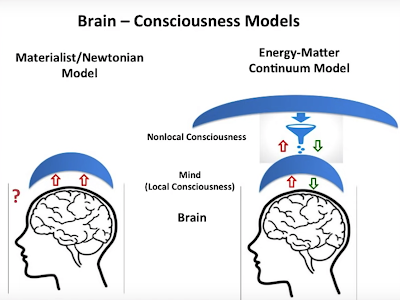
"Models of Consciousness: Determinants of Our Lived Reality If you believe in a materialist model that considers consciousness beyond the human waking, dream and sleep states to be abnormal or nonexistent, this will limit your sense of interconnection. But if your model includes a continuum of consciousness within everything, the feeling of connection inherent in this model will naturally generate compassionate action: you understand that what happens to others also happens to you. Regardless of which model you accept, a key question is whether you are open to modifying your understanding based on emerging evidence regarding the nature of consciousness? Here is how the astrophysicist Bernard Haisch explains the strong grip of the medical model on modern science and our culture:
'Modern
Western science regards consciousness as an epiphenomenon that cannot
be anything but a byproduct of the neurology and biochemistry of the
brain. While this perspective is viewed within modern science as a fact,
it is in reality far stronger than a mere fact: it is a dogma. Facts
can be overturned by evidence, whereas dogma is impervious to mere
evidence.' Bernard Haisch quoted in: David J. Chalmers. "The Conscious Mind. In Search of a Fundamental Theory."1997, p53
Consider
whether you are open to expanding your existing model of consciousness.
As our model of consciousness expands, our experience of connection
with everyone and everything around us expands as well. And this, in
turn, can lead to an increased capacity for compassion and for actions
by which we can heal ourselves and our planet." Marjorie Woollacott PhD neuroscientist https://www.huffpost.com/entry/our-models-of-consciousness-how-they-shape-our-reality_b_59270990e4b0aa7207986b94
Consider the story of this, now middle-aged, lady who had a near death experience (NDE) at 4 years of age. For much of her life, she only remembered the dark, scary components of her NDE, causing her to fear the dark & falling asleep. This terror was triggered when as an adult she was advised to have a general anesthesia (GA) for an operation. A brief excerpt:
“And suddenly it terrified me, with hot & cold shivers going through my body, that in essence it meant giving up control of one’s own consciousness. For about a quarter of an hour I was just going through the feeling of the essence of that loss of control, and tears washed down my face when I had to think about it. That this is the essence of dying, to just let go, to dive down without any ground under your feet. That this is the step out of control, like in death."
During the GA, she finally remembered all the positive bright, loving, safe, welcoming components of her NDE, and lost her fear of the darkness, sleep, general anesthetic & death. Sometimes, when we lack the courage to accept that which we fear, life overwhelms our childish ego's feeble illusion of control, allowing us finally to see the reality that is here, yet beyond our simplistic materialistic ideas about reality.
"If we let go of the rational control over our own consciousness, we can get somewhere that forms us and that also forms the universe. I acknowledge that this is, in my opinion, a very important state of mind, a very important process for us all.”
We all know that feartriggers our strong survival instinct to control (fight, flight, freeze). However, as the Serenity Prayer (top of the page) suggests, this drive to control is only appropriate & helpful if the situation can be controlled.
When we transcend fear - which is often a hard-earned skill, then acceptance, love & connection with a profoundly better, infinitely greater reality opens up.
Most of us start meditating to get a better handle on stress - just part of our seeking agency over every aspect of life. Up till now, our focus has almost exclusively been on externals (things outside ourselves). Taming the external environment to our needs is the dominant theme of the first half of life - an important, necessary step. But we soon find that meditation involves a very different approach from what we're used to.
“… of external facts we have had enough and to spare, more than the squirrel-like scholars will ever be able to piece together into a single whole, enough to keep the busy popularizers sprouting in bright-eyed knowledgeability the rest of their days; but of the inner facts – of what goes on at the center where the forces of our fate first announce themselves – we are still pretty much in ignorance…” William Barrett
Around middle-age - when loved ones start to become sick & die - we may begin to realize that, despite all our striving, we have shockingly little control over the most important aspects of life. So for those ableto age wisely, the theme for the second half of life shifts progressively towards discovering the internal aspects of life - a relatively mysterious dimension or level of consciousness that we've essentially overlooked - till now. After a lifetime of manipulating the external mechanical world of solid objects ("hard science"), shifting focus to deeply investigate our inner life (metaphysics, spirituality) is the most radical challenge we've ever faced. See also: http://www.johnlovas.com/2019/04/wisdom-for-second-half-of-journey.html
"Spirituality
addresses qualities of the human spirit that include love, compassion,
patience, tolerance, forgiveness, a sense of responsibility, which
brings happiness to self and others. It as well includes a basic concern
for the well-being of others. And it has an emphasis on contemplative
practices cultivating ethics, stability, and prosocial mental
qualities." Dalai Lama
Manycannot make this shift, because: • Our society's unspoken dogma is scientific materialism: the belief that physical reality, as made available to the natural sciences, is all that truly exists. As in religious exclusivism, all other worldviews are denounced. • The founders of major religions set out to train peoples' intelligences to deal with spiritual matters however religious organizations have severely damaged their own credibility, competence & relevance. • Our identity - 'self-image' - is built around being specialized in & competent at controlling & surviving in the external world. Now, we suddenly realize that our control is declining & survival was never possible. AND we need a very different set of skills to start exploring an 'inner world' - a task for which we feel utterly incompetent! These & other factors leave many people - especially in the second half of life - feeling profoundly uprooted, adrift & helpless to address the now most urgent, meaningful & profound aspects of their life.
Of course turning science into a dogmatic quasi-religion, complete with 'religious exclusivism,' clearly violates scientific principles. Nevertheless, like partisanship, dogmatism is becoming increasingly common. “... dogma ... a coherent, universally applied worldview consisting of a collection of beliefs and attitudes that demand intellectual and emotional allegiance. Dogma wields power over individuals and communities that is far greater than the power of mere facts and fact-related theories. Indeed, a dogma may prevail despite the most obvious contrary evidence, and commitment to it may become even more zealous when obstacles are met. Thus, dogmatists often appear to be incapable of learning from any kind of experience that is not authorized by the dictates of their creed. … The antidote is the restoration of an authentic sense of empiricism and a willingness to put cherished beliefs and assumptions to the test of experience.” B. Alan Wallace PhD Perhaps more importantly, popular religion is qualitatively distinct from the practice & resultant direct experience of serious spiritual seekers, meditators, mystics & saints: “… the spiritual is inclusive. It is the deepest sense of belonging and participation. We all participate in the spiritual at all times, whether we know it or not. There’s no place to go to be separated from the spiritual, so perhaps one might say that the spiritual is that realm of human experience which religion attempts to connect us to through dogma and practice. Sometimes it succeeds and sometimes it fails. Religion is a bridge to the spiritual - but the spiritual lies beyond religion. Unfortunately in seeking the spiritual we may become attached to the bridge rather than crossing over it.” Rachel Naomi Remen MD
"Nothing in life is to be feared, it is only to be understood. Now is the time to understand more, so that we may fear less." Marie Curie
What does serious spiritual / meditation practice lead to? “My sense of it is that awakening (enlightenment) is the knowing in your cellular being that you are not the character you thought you were; that you are this pure consciousness that has created everything. Something like that. You can’t put it into words. So if that should happen, if that’s known, really known in your cells (not in your head, it doesn’t help much to just have it in your head), then that doesn’t go away. It’s kind of like knowing I’m a man or a woman. Once you figure that out, you don’t have to keep reminding yourself. It’s just sort of there. That’s the form you happen to have at this time of your life. It’s not an intellectual knowing. It’s not something you’re likely to forget. It’s a much more visceral or cellular knowing. The other aspect of it is that when you’re feeling it and it becomes more accessible to you, to fall back into that, there’s tremendous peace and tremendous acceptance of what is in the world. There’s no more resistance. One of the things you could say is no more division."Bonnie Greenwell PhDhttps://www.youtube.com/watch?v=Q2U5bAISZU4
“There’s one proof of awakening & liberation: ‘Are you still in conflict? Do you experience emotional and psychological conflict?’ If you do, it doesn’t mean that you have to throw out everything you realize, but it means there might be more to see. That’s the liberation part – the disappearance of conflict – no more argument with yourself, no more argument with God, no more argument with the world, and no more argument with death. Then all the arguments are gone – now we’re talking about something significant.” Adyashantihttps://batgap.com/adyashanti/