Showing posts with label connection. Show all posts

Wednesday, March 19, 2025

Growing Older AND Wiser

    The material below is neither monetized nor weaponized. It is solely to provide nurturing nutrition to those hungering for wise human connection.
    Below
is my transcript of the first 30 minutes of the superb talk, "Spirituality in Later Life" by the respected elder psychiatrist & Jungian analyst Lionel Corbett: https://www.youtube.com/watch?v=GrwnNxK1xk8&list=PLX31T_KS3jtpu1mC82KpWzbx4MvOW8e1a&index=9

    “For Jung, the innate God image in us – the Self – which is a kind of Divine essence or core of the personality – will give us a set of potentials, and these potentials have to embody themselves as we live our life. And this process comes to a final development in later life. And one of the major developments in later life is the consolidation of a relationship with the Self.
    I want to begin with one of the ways that we form a relationship with the Self. The main approach is by paying attention to dreams. So I want to talk about a very numinous dream about aging, which was given to a woman in her late sixties who was very worried about the prospect of aging. This is an example of what’s called a numinous dream.
    Very briefly, numinous experiences are experiences of the Self or the transpersonal level of the unconscious. They’re experiences that have a mysterious, fascinating, awesome quality. Examples are Moses at the burning bush, or Saul on the road to Damascus - those kind of experiences where one is faced with some uncanny, larger power or otherness that defies adequate understanding. Now one of the main sources of this kind of experience is in a numinous dream.
    And the main point about this, from a Jungian perspective, is that we can’t Christianize the unconscious. The unconscious will produce imagery from any religious or mythological tradition, with no regard for the subject’s preferences, the subject’s personal history, and so on. It may contradict official teaching. And I want to give an example of the dream which does just that.
        This dream, like many numinous experiences acted as an initiation into the aging process. Sometimes when we’re in a transitional period, the Self will produce imagery which initiates us into the new consciousness that’s required.
        Now this is the dream that occurred to a woman who was quite concerned about the losses and the physical decline that we’re all very well-aware of in later life. The problem is that we have no socially-sanctioned initiation into old age. Old age tends to be devalued in our culture, and people break down emotionally during transitional periods because of the uncertainty that we experience during these liminal or transitional periods. And the transitional period into late life is no exception.
    So here’s the dream that the woman had which helped her. I’m going to abbreviate it a little bit.
    In the dream an authoritative voice says, ‘I’m going to teach you about the process of aging.’ By and large, voices in dreams tend to be experienced as the voice of the Self. So in the dream the woman sees (Dreamer's Drawing below) this black & white diagram, and underneath the diagram is the head of a very old man – this is her drawing. And you see there’s a connecting line drawn from the old man’s head to the diagram. And the diagram consists of an elongated sort of square shape enclosing an inner circle – the so-called squaring of the circle which is very familiar to people who know alchemy. And at the bottom of the circle is this crescent convex upward, and out of the crescent arise two heads on long necks.
    And the voice says, ‘This is an abstract of the Godhead and there are two heads of God – one is the male head of God, and one is the female head of God.’ So the dreamer realizes that the heads are in harmony with each other, their faces are sort of curiously unemotional and there’s a kind of crown at the top of each head, and ‘The old man,’ she says, ‘looks ordinary and earthy, with kind of reddish skin.’ And the voice goes on to say, ‘You don’t understand the process of aging. The process of aging, the reason that we age, is to enable God to rejuvenate.’ And the voice says, ‘When we are born, God is old. When we grow old, God becomes young and when we die, God experiences rebirth.'
    Particularly in old age, it’s very important that we don’t lose our connection to God because otherwise we would deprive God of our share in God’s rejuvenation and this disturbs the cosmic ecology. And the voice goes on to say that, ‘Belief in 
God constellates the inner child and this fosters the process of Divine rejuvenation, and as we age, we mustn’t lose touch with the inner child because if we do, we also lose touch with the Divine. '
    Now this is a deeply mysterious dream. It’s the kind of dream that Jung thinks arises from the archetypal level of the psyche – the mythopoetic level – the level that’s the source of all religious experience. It’s a numinous dream, it’s mysterious, tremendous & fascinating, and it doesn’t contain Judeo-Christian imagery. In fact, if anything, the image of an androgenous Divinity with both male and female heads contradicts the tradition that has an overly masculine image of God. Now the dream says that the purpose is the rejuvenation of God and this is a completely novel idea which the dreamer of course didn’t understand, but somehow she found it very reassuring, because she got the sense that aging is not just a period of relentless decline towards death. She got the sense from the dream that this phase of her life had a purpose and in fact it’s very typical of numinous experience of this kind to have a kind of helpful or healing effect, which it was for her.
    The dream is also what’s called a ‘big dream.’ In other words, it’s not just relevant to the dreamer, it’s relevant to all of us, to society as a whole. It’s also a revelation of the individual’s personal myth. She’s given a kind of personal revelation instead of just participating in a collective revelation like say the receiving of the law on Mount Sinai or something like this, we are given individual revelations when we pay attention to this kind of manifestation of the Self. This dream allows the dreamer to distinguish herself from the collective myth into which she was born, the collective myth that we’re born into is based on nationality, ethnicity, collective conditioning, but in this kind of way, by paying attention to this kind of imagery, we can discover our own spirituality, we don’t have to participate in a kind of mass consciousness. Jung said that you can only resist the influence of collective thinking if your own individuality is well organized. And again, this is one of the main tasks of later life.
    This is a good example of how the God image can change as we age. The dreamer was raised in a tradition whose God image is exclusively masculine, so when the dream says that the Divine has a feminine head as well as a masculine head, this was a very important corrective. And the dream also gives her a kind of abstract image of the Self, the bigger Self as a totality, the squared circle which is neither masculine nor feminine. So it’s telling her that the Self has these kind of human levels and abstract or transpersonal levels.
    Now it was very difficult for us to know what the dream meant by ‘the rejuvenation of God’ or what it could mean that ‘when we’re born God is old, but as we get older, God gets younger.’ I mean it sounded to me like a kind of Zen koan. So one way is to think about this as a comment on the image of God in the psyche or the way the Self appears to us. So when we’re born, we are immersed in the God image of a particular tradition which is old, it’s been around for a long time, so in that way, God is old. But as we age, our God image changes, sometimes radically, and I think that’s what the dream means when it says that God becomes younger. It means the God image gets younger as we work on it. The dream stresses the importance of maintaining a connection to the inner child. So this is a very important teaching. This is of course a teaching dream, and of course in many traditions the Divine appears in the form of a child. Think of the mythologies of Jesus, the Buddha, Oris, and Krishna – all these Divinities appear in the form of Divine children, usually implying renewal and regeneration
.
    So
as we age, the dream says we have to cultivate a more childlike approach to the Divine, reminiscent of Jesus calling on people to become like little children if they want to enter the kingdom of heaven. I think this means we have to cultivate a simple faith, and trust not a dominant ego. We have to behave in a trusting way, the way that a child relates to a good parent. So this woman’s God image was radically transformed by her dream illustrating Jung’s point that as we go more and more into the unconscious, we transform our God image.
    Now I find that this kind of contact with the transpersonal level of the psyche or with the Self is very helpful during a life crisis and old age is full of life crises of this kind because of the inevitable losses we experience at this time. So attention to dreams in later life is very important because it becomes a powerful stimulus to the individuation process. We get the sense as we pay attention to this kind of dream image that we are witnessed or supported by a larger presence than the ego, and this feeling helps us to develop a personal spirituality, without any commitment to a specific tradition.
    Now one of the effects of a dream like this is what Jung calls the 'relativizing of the ego.' What Jung means by this is that as we age, we discover, more and more that we are, in his words, the object of a supernatant. In other words we increasingly realize that something is aware of us. The Self is aware of the ego. The ego is not the essence of who we are. We are really part of this larger Self. And this is what’s meant by the 'relativizing of the ego.' We live in relation to a larger wisdom that determines a large part of our destiny behind the scenes. We relativize the ego also by giving up our grandiosity, our feelings of omnipotence, and we work on character traits like the need to control other people, the need for status, the need for external sources of self-esteem. These are all ways in which the hegemony of the ego decreases as we become more open to the demands of the Self in later life without resistance.
    And this leads to the question of surrender and letting go in later life which I’ll come back to in a few minutes. [[Please DO listen to / watch this WHOLE video: 
https://www.youtube.com/watch?v=GrwnNxK1xk8&list=PLX31T_KS3jtpu1mC82KpWzbx4MvOW8e1a&index=9 ]] In the meantime, just a few other aspects of development in later life that are both psychologically and spiritually very important.
    One is the development of wisdom. This has several meanings. It partly means the ability to be non-judgmental when relating to others and the way that happens is that as we age, we increasingly develop our capacity for empathy for other people. The more we can be empathic with other people, the less judgmental we are of other people. And I find that empathy is one of those faculties that often develops as we age.
    Wisdom also means the ability to maintain more than one perspective at the same time, to see a situation from multiple points of view. Also the capacity to live with paradox increases as we age. And also as we age, we get better at tolerating ambiguity. Wisdom also means that we can broaden our horizons beyond our own ego concerns, beyond the concerns of our own community so that we become concerned with humanity as a whole and the situation that’s going on around us at the moment is a very good example of how we need to do that.
    Now this discovery of the Self is actually a monumental realization, but the evidence for it is overwhelming when we see the accuracy of our dreams and the accuracy of synchronistic events which are also stimulated by the Self. These are so closely tailored to our psychological structures that we realize that we’re being addressed by an intelligence that understands us better than we know ourselves.
    Now a few words about some other aspects of spirituality in late life. You’ll remember that Jung said that after midlife, none of his patients recovered unless they developed a religious attitude. By 'religious attitude,' he didn’t mean commitment to a specific tradition or a specific creed. He meant the development of a personal spirituality. He meant an individual connection to the Self or to sacred reality. This actually is the core of Jung’s approach to spirituality at any time of life. 

    ... religion is an organized, historical institution that’s been around for a long time, and spirituality in the broad sense, is simply the feeling that life is meaningful and in some way that we have a personal connection to subtle realities beyond the physical world, however you think about them, or you can define spirituality broadly as the capacity to experience mystery, beauty, awe, and the ability to affirm the value of life.

     Belief in a set of doctrines and dogma is not enough. That’s not an adequate basis for faith. Belief in traditional ideas may fade or may be eroded by painful life events. If you believe in a loving, benevolent God and then you have a catastrophic life event, your belief in that particular God image may be shattered. In the face of intense suffering, the teachings of the established traditions about how loving and good God is, can seem like mere platitudes. They can have no emotional power. And in fact then you may need a notion like Jung’s notion that the Divine has a dark side to it. [[ Please do read Sue Morter's "BUS STOP CONVERSATION" AND watch Natalie Sudman's video: http://www.johnlovas.com/2023/01/the-nearly-unforgivables.html ]]

      So belief in doctrine and dogma may not be helpful but direct personal experience of the Self, personal numinous experience is actually indelible. It leads to knowledge rather than belief, and knowledge is permanent. Once you have this kind of experience, once you’ve heard the voice of the Self, you know, you don’t have to believe.
    So an authentic spirituality is greatly enhanced by personal experience of the transpersonal psyche. This is why for Jungian psychology it’s actually impossible to sharply distinguish between psychological and spiritual development in late life. They overlap, and in fact I think they’re synonymous. So I would ignore the distinction between psychology as a discipline that’s only concerned with this world and personality, while religion has attention to spiritual matters.
    I think using this kind of approach you can seamlessly blend a spiritual and the psychological because the psyche is not purely personal. It has personal levels but it also has a spiritual, or a transpersonal dimension, the mythopoetic dimension that is the source of religious experience and acts as a very important background force within the life of the individual. The transpersonal unconscious is a source of wisdom greatly superior to the ego.
    So whereas in early life one has to develop an early ego, the older person in particular has to realize that the ego exists in relation to the Self and that a dialog is possible between them. And when this dialog is established, the issue of meaning often comes to the fore, because these experiences are intensely meaningful. And one of the cardinal features of spiritual development actually at any age, but particularly in later life, is the discovery of meaning in one’s life.
    The sense that life makes sense it’s not a tale told by an idiot. Without meaning one often despairs. And this discovery begins to be important in midlife, but becomes very important in later life, especially as we start to accumulate multiple losses & limitations. The development of meaning helps us avoid the sense that life has been nothing more than an inexorable struggle against an indifferent fate. We don’t have any control over the losses that occur in old age, but we are free to discover meaning and we are free to pursue a spiritual practice such as work with dreams which in turn allows us to be less vulnerable, less vulnerable to despair than would be the case if life seemed entirely meaningless.
    One of the difficulties we have here is that our culture doesn’t ask about the meaning of old age. Society’s main interest in aging is the medical & social management of late life. But the major task for the inner world is discovering the meaning and purpose and value of aging. This falls to the individual. There are no cultural norms that the individual can use.
    So meaning refers partly to the ability to discern a pattern in your life, to make connections between elements of your life that otherwise seem disconnected so that you can see that your life has formed a coherent pattern or theme. Sometimes you find a theme that’s moved through the whole course of your life. And you can discover this theme as you tell the story of your life. Storytelling is a very important spiritual practice which helps you discover who we are – the so-called life review – telling the stories about what’s happened in our life. This makes life events more meaningful than would be the case if we were to see events in isolation, with no connection to each other. Telling a story, telling what’s happened to us requires a life review and this can be very painful, so I think it is a process that has to be approached cautiously, because sometimes it means looking at the discrepancies between the fantasies that we had early in life, the way we hoped life would unfold, and the way in which life actually unfolded. And as we do this kind of work, we find that a great deal of grief emerges. We have to look at disappointments. We have to look at goals that we had that we now realize will never be met, and so on.
    But at least telling the story helps us make sense of life. And telling the story to other people is an important means of connecting to other people. And it’s an important means of passing on wisdom to other people. Whatever wisdom one has acquired, one can pass on to the family. One becomes, as an elder, the repository of all the family history and all the wisdom that one has acquired can be passed on ideally to the next generation. This is what Erikson meant by generativity in later life
.
    Now
sometimes we feel that our life has been guided to follow a particular pattern as if we have a kind of transpersonal calling. Jung calls this the ‘spiritus rector’ [[ the central, guiding wisdom of the unconscious that directs the psyche towards wholeness and health. It's the inner wisdom that provides guidance when facing difficult situations or feeling lost ]] or the guiding spirit, which is the Self within the personality, and that’s what he meant when he said that each life has its own ‘telos’ – its own goal, its own purpose, its own endpoint, and its own vocation really, that each personality has an end or a goal that’s given by the Self. And the problem is how to discern it. The work on dreams and the individuation process is one way to discern that process.”
    Lionel Corbett "Spirituality in Later Life" : https://www.youtube.com/watch?v=GrwnNxK1xk8&list=PLX31T_KS3jtpu1mC82KpWzbx4MvOW8e1a&index=9

Numinous Dream Image drawn by Lionel Corbett's patient


Wednesday, May 24, 2023

The Most Important Thing

    “The most important thing is to remember the most important thing.” Shunryu Suzuki-Roshi

    In his fine recent blog, Ron Epstein wrote that for his mother, who had dementia & stage IV lung cancer, "Remembering the most important thing and forgetting the rest helped her to live with calmness, agency, gratitude, & dignity." https://mindfulpracticeinmedicine.com/remembering-and-forgetting/
    This
wonderful human capacity to thrive, even in situations that we usually fear & try desperately to avoid, is also found among : serious meditators & contemplatives, those who've had post-traumatic growth, near-death experiences,
taken entheogens in carefully-controlled settings, etc. http://www.johnlovas.com/2021/03/fascinating-overlap.html

    Fear and our survival instinct's (understandable) obsession with keeping us alive, despite the inevitability of death, keeps most of us at least a little disturbed for much of our life. The above groups, probably accounting for more than half of us, experience a radical shift in focus of attention from fearful, closed-down self-centeredness, to a profound heart-opening & loving connection with others.

    “We suffer to the exact degree that we resist having our eyes & hearts opened.” Adyashanti

“All the joy the world contains
Has come through wishing happiness for others;
All the misery the world contains
Has come through wanting pleasure for oneself.” 

 Shantideva

     As we age, we can't help but notice how even our most basic physical, and some of our intellectual skills, are progressively diminishing. Then as we look at our aging loved ones, friends and even strangers we finally know through direct experience that indeed "everyone is carrying a heavy load." And so, our competitiveness & judgmental tendencies gradually evaporate, and we begin to wish the best for all the rest of humanity limping home.

    "meditate one-pointedly on patience & love until they take root in your being.” Dilgo Khyentse Rinpoche

    “… the larger ties that bind us – ties of love, connection, purpose – have ripple effects on our health and the world at large.”
    Kelli Harding. “The Rabbit Effect. Live Longer, Happier, and Healthier with the Groundbreaking Science of Kindness.” Atria Books, 2019.


Light Voyagers, oil on canvas, © Copyright, Mark Henson  Markhensonart.com

Monday, August 1, 2022

First, Self-Compassion

“I was meditating with my cat the other day
and all of a sudden she shouted,
‘What happened?!’
I knew exactly what she meant, but encouraged
her to say more – feeling that if she got it all out on the table
she would sleep better that night.
So I responded, ‘Tell me more, dear,’
and she soulfully meowed:
‘Well, I was mingled with the sky. I was comets
whizzing here and there. I was suns in heat, hell – I was
galaxies. But now look – I am
landlocked in fur.’
To this I said, ‘I know exactly what you mean.’
What to say about conversation between mystics?”
    Tukaram “Landlocked in Fur” in: “Love Poems From God: Twelve Sacred Voices from the East and West” Ladinksy, 2002.

    Don't we all feel 'landlocked in fur' - trapped in our imperfect body & imperfect life? Perhaps we all have a vague memory of being not just stardust, but the Source itself.
    But
for this very brief life ...


“Forget about enlightenment.

Sit down wherever you are
And listen to the wind singing in your veins.
Feel the love, the longing, and the fear in your bones.
Open your heart to who you are, right now,
Not who you would like to be.
Not the saint you’re striving to become.
But the being right here before you, inside you, around you.
All of you is holy.
You’re already more and less
Than whatever you can know.
Breathe out, touch in, let go.”                 
John Welwood


    Tara Brach has a wonderful talk about this: https://www.youtube.com/watch?v=lcb2UNwOKEA 


    Then, we're able to greet ourselves & others with 'Namaste':

     “A soul connection is a resonance between two people who respond to the essential beauty of each other's individual natures, behind their facades, and who connect on this deeper level. This kind of mutual recognition provides the catalyst for a potent alchemy. It is a sacred alliance whose purpose is to help both partners discover and realize their deepest potentials. While a heart connection lets us appreciate those we love just as they are, a soul connection opens up a further dimension -- seeing and loving them for who they could be, and for who we could become under their influence. This means recognizing that we both have an important part to play in helping each other become more fully who we are.... A soul connection not only inspires us to expand, but also forces us to confront whatever stands in the way of that expansion.” John Welwood


Saturday, February 12, 2022

Beyond Even the Fear of Losing Control

     Our usual mindset or operating system is based on our society's (mostly unexamined) assumption that ONLY physical stuff (matter) is real, because we can all see, feel & therefore agree upon it. Most of us have inadequate training & understanding of either science or of metaphysics ("the branch of philosophy that studies the fundamental nature of reality, the first principles of being, identity & change, space & time, causality, necessity, & possibility. ... the nature of consciousness and the relationship between mind & matter ... 'metaphysics' ... literally means "after or behind [the study of] the natural*." wikipedia.org - *"natural" implies physical stuff). Metaphysics, in simple terms, refers to everything OUTSIDE of our tiny "box" of information, which, for some ONLY contains physical "stuff." Though sometimes encouraged to do so, most of us simply can't or won't "think outside the box" because leaving this "comfort zone" of dogmas & other (incorrectly) assumed certainties, requires more bravery, open-mindedness, creativity, & energy than most of us have. So we often need to graduate from the school of hard knocks to crack open our numb skulls & hard hearts. 

         There is a crack, a crack in everything
         That's how the light gets in
                  Leonard Cohen, "Anthem"

         "Grant me the serenity to accept the things I cannot change;
          courage to change the things I can;
          and wisdom to know the difference."
     Reinhold Niebuhr's "Serenity Prayer" - later adopted & popularized by Alcoholics Anonymous & other 12-step programs - is profoundly wise, AND YET many of us have to "hit rock bottom"
before we take it seriously. Our society frantically chases after short-term pleasures while values such as serenity & wisdom are forgotten. Few can define these terms, never mind live them.

     We're like a small sailboat out in the middle of the ocean.
    
Religion was meant to be our sailboat's ballast, allowing us to maintain a steady course, without capsizing in storms. As with other large businesses that mass-produce heavily-processed stuff eg junk-foods, organized religions continue to devolve from an idealistic mission eg optimal nutrition, down to maximizing "market share," mission be damned.
     Scientism. The
remarkable impact of scientific innovations and the resultant readily-available cheap consumer items easily converted many from anemic religions to true-believers in "scientism" - the pseudo-religious belief in "stuff," containing the most toxic elements of theistic religion (dogmatism & exclusivism), but none of the most intelligent, vitally important elements of science.

     A few words about science. Most (including "hard science only" fans) assume that "science" refers only to "natural sciences" (biology, chemistry & physics) which deal directly with matter/energy. Here, only physical matter / energy is studied, because only these can be (readily) measured, so that others ('third parties') can repeat the experiment, 'objectively' proving or 'refuting' the validity of the measurements.
     Seldom
recognized by the public, though critically important, is that the object of scientific interest typically must to be removed / isolated from its natural surroundings (taken out of context***) & brought into a sterile laboratory so that the study can focus ONLY on the experimental object.
    
Rarely (never?) mentioned now, though this was a standard disclaimer at the end of every scientific paper until ~40 years ago, went something like, 'the results of the present study are valid only under the described experimental conditions, and conclusions cannot be made beyond the present
experimental conditions.' TWO important ramifications of this disclaimer:
     1)
If another lab's
methods deviate at all from the original lab's, they should get different results, and so it cannot disprove the original lab's results.
     2)
The process of removing the object
from its native environment for scientific study, unavoidably causes varying degrees of damage. Further damage then occurs as the isolated object is exposed to a completely foreign, often inhospitable lab ('in vitro') environment. Still further damage occurs when the object is subjected to experimental stimuli - the "experimental conditions".
     These
represent BOTH a strength, AND a limitation of the scientific method. The strength: isolation allows scientists to study the object of interest, with minimal contamination by other objects, be it from the objects natural environment, or the lab itself. The limitation: given how
even a slight difference in methodology (eg lower temperature) between labs changes the results of the experiment, how closely can we expect our lab findings of the profoundly damaged, isolated object compared to when it's undisturbed, functioning harmoniously with its natural environment? Hidden here also a key materialist dogma - the belief in the primacy of matter, which here implies that we should be able to build anything, including human life itself, from basic building blocks. Critics correctly call this clear limitation & increasingly questionable dogma, "reductionist" - analyzing & describing a complex phenomenon in terms of its simple or fundamental constituents. Varying degrees of isolation, manipulation & simplification are necessary, regular, normal aspects of science BUT this, often radically simplified model, can only provide hints about complex reality. *** It's very useful to remember that patients who suffer a stroke of the right hemisphere, by loosing context, are profoundly handicapped, vs the left hemisphere (loosing narrowly-focused task-orientation) are, despite also loosing the ability to speak & important motor skills, are far less handicapped.
    Below
, even more potential surprises about real science:

      Thomas
Kuhn's classic, 'The Structure of Scientific Revolutions' intelligently describes scientific progress. "... science changes, adapts, and specializes to fit the times. It does not work toward some absolute 'truth,' but merely continues its work of studying and understanding the world.
     Many
people have the idea that science progresses in a linear fashion—a straightforward march from ignorance to knowledge. If that were true, then there would be no such thing as scientific revolutions; old ideas would never need to be overturned, only built upon.
     However
, not only do scientific revolutions happen, they follow a specific pattern. The Structure of Scientific Revolutions lays out this pattern clearly and labels each part of it. The parts are:
          1) Normal
science: The process of adding to existing knowledge through experiments and study.
          2) Puzzle-solving: Finding and fixing discrepancies in science as we currently understand it.
          3) Paradigm: ... a paradigm could be seen as a perfect example of an idea, which can be expanded into the framework of a whole field of scientific understanding. For example, think about the evolution of humans from a more ape-like ancestor. Using that paradigm, evolutionary biologists form the framework for all of their studies.
          4) Anomaly: Someone finds a discrepancy between the current paradigm and experimental results.
          5) Crisis: The discrepancy can’t be resolved. Scientists loyal to the current paradigm try to dismiss it, while others try to show that the current paradigm is wrong.
          6) Revolution: The old paradigm is overthrown by new information, and eventually a new one takes its place—a 'paradigm shift.' There have been many such revolutions in history that completely changed the way people understood and approached the world."
https://www.shortform.com/summary/the-structure-of-scientific-revolutions-summary-thomas-kuhn?gclid=Cj0KCQiA0p2QBhDvARIsAACSOOMmoBYMECSzkKRKJzS7FE-4GF1pWw0Gpm694tLTYiajFjmBTBdZejkaAh2FEALw_wcB

     It's "only human" to resist change, especially when one's ego, prestige, livelihood & (false) identity depend on defending outdated ideas & ways of thinking. However, when mounting new evidence is ignored, suppressed, ridiculed & shamed, it's because of dishonesty & incompetence, typical of religious cults, but has no place in science, nor meaningful religions.

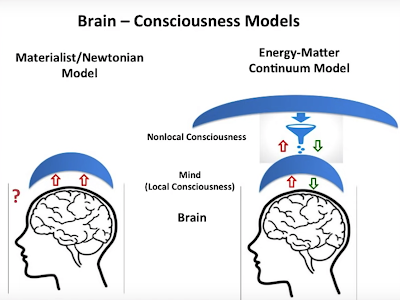
"Models of Consciousness: Determinants of Our Lived Reality
     If you believe in a materialist model that considers consciousness beyond the human waking, dream and sleep states to be abnormal or nonexistent, this will limit your sense of interconnection. But if your model includes a continuum of consciousness within everything, the feeling of connection inherent in this model will naturally generate compassionate action: you understand that what happens to others also happens to you.
     Regardless of which model you accept, a key question is whether you are open to modifying your understanding based on emerging evidence regarding the nature of consciousness? Here is how the astrophysicist Bernard Haisch explains the strong grip of the medical model on modern science and our culture:
'Modern Western science regards consciousness as an epiphenomenon that cannot be anything but a byproduct of the neurology and biochemistry of the brain. While this perspective is viewed within modern science as a fact, it is in reality far stronger than a mere fact: it is a dogma. Facts can be overturned by evidence, whereas dogma is impervious to mere evidence.'
    
Bernard Haisch quoted in: David J. Chalmers. "The Conscious Mind. In Search of a Fundamental Theory."1997, p53

     Consider whether you are open to expanding your existing model of consciousness. As our model of consciousness expands, our experience of connection with everyone and everything around us expands as well. And this, in turn, can lead to an increased capacity for compassion and for actions by which we can heal ourselves and our planet."
     Marjorie
Woollacott PhD neuroscientist https://www.huffpost.com/entry/our-models-of-consciousness-how-they-shape-our-reality_b_59270990e4b0aa7207986b94

     Consider the story of this, now middle-aged, lady who had a near death experience (NDE) at 4 years of age. For much of her life, she only remembered the dark, scary components of her NDE, causing her to fear the dark & falling asleep. This terror was triggered when as an adult she was advised to have a general anesthesia (GA) for an operation. A brief excerpt: 
     “And suddenly it terrified me, with hot & cold shivers going through my body, that in essence it meant giving up control of one’s own consciousness. For about a quarter of an hour I was just going through the feeling of the essence of that loss of control, and tears washed down my face when I had to think about it. That this is the essence of dying, to just let go, to dive down without any ground under your feet. That this is the step out of control, like in death."
     During the GA, she finally remembered all the positive bright, loving, safe, welcoming components of her NDE, and lost her fear of the darkness, sleep, general anesthetic & death. Sometimes, when we lack the courage to accept that which we fear, life overwhelms our childish ego's feeble illusion of control, allowing us finally to see the reality that is here, yet beyond our simplistic materialistic ideas about reality.
    "If we let go of the rational control over our own consciousness, we can get somewhere that forms us and that also forms the universe. I acknowledge that this is, in my opinion, a very important state of mind, a very important process for us all.”

     See Marjorie Woollacott's imho excellent 65min lecture on NDEs, Meditation & Consciousness: https://www.youtube.com/watch?v=BGi39C5Ysk8&list=PLZwmf_5L38HgyTfPnr3hohBbP_-okYhGX&index=1

     We all know that fear triggers our strong survival instinct to control (fight, flight, freeze). However, as the Serenity Prayer (top of the page) suggests, this drive to control is only appropriate & helpful if the situation can be controlled. 
     When we transcend fear - which is often a hard-earned skill, then acceptance, love & connection with a profoundly better, infinitely greater reality opens up.
 

Marjorie Woollacott PhD


Saturday, August 14, 2021

More Conscious Awareness

      Our health & quality of life depends on our becoming consciously aware of who we truly are, as well as what influences our behavior. Both of these require deep self-reflection & meditation. The former is profoundly helped by advanced meditation & self-inquiry practices; the latter by Jungian analysis (depth psychology), Internal Family Systems (IFS), Transpersonal Psychology etc.
     Sadly, our
current society, is not only ignorant about, but actively & passively discourages self-reflection, serious meditation, & sustained attention to anything of substance. 

               “For what is not available in our culture
                we are now obliged to find for ourselves.”         James Hollis

     “The mother complex, that is, the affectively (emotionally) charged idea of mother, is in us all. It is experienced as the longing for warmth, connection and nurturance.
     When
one’s initial experience of life met these needs, or largely so, one feels that one belongs in life, that here is a place where one will be nurtured and protected. … the child will feel more grounded in his or her own reality and more trusting of the world around. As Freud once observed, the child who has the mother’s devotion will feel invincible.     

     Where the primal experience of the feminine was conditional or painful, one feels deracinated (uprooted from one's natural geographical, social, or cultural environment), disconnected. Such an ontological wound is felt in the body, burdens the soul and is frequently projected onto the world at large. One’s entire Weltanschauung (philosophy, view of life, worldview) can derive from this largely unconscious, phenomenological ‘reading’ of the world.

     I have seen a considerable number of men in therapy whose need for mothering is so extensive that they are doomed to be dissatisfied with their wives. While it is clear that women do not want to be mothers to their husbands, it is also clear that many men seek in their wives the sort of unconditional acceptance and nourishment associated with positive mothers. Indeed, I have seen many men stuck in marriages that were dreadful for various reasons but they were unable to countenance the idea of leaving. Departure held all the terrors of the child leaving home for the unknown. Sexuality, in particular, is freighted with the infantile need for bodily contact and nurturance. As women grow weary of taking care of little boys, so little boys find it harder and harder to leave home and grow up, since neither father nor the fathers are available to show the way.
     When men feel the push-pull of the mother complex they are apt to confuse that power with the outer woman in their life. Just as they often regress in intimate relationships, making a mother of their partner, unconsciously demanding she be ‘the good breast,’ so they fear and oppress women, as if by controlling them they might master the fear of their own undertow. The sorry history of men’s treatment of women is stark testimony to this. One oppresses what one fears. Fear is responsible for the oppression of women and for gay bashing, the latter most notably by young men insecure in their on psychological reality. The resistance President Clinton encountered in proposing to end the ban on homosexuals in the American military was not because there were no homosexuals already serving bravely and honorably, nor because regulations regarding sexual harassment were not already in place, but because of the macho man’s fear of his own feminine side.
     Machoism is in direct proportion to man’s fear, and the banding together of fearful men is the breeding ground of violence and the tacit admission of the power of the feminine in their lives. Vast bastions of macho mentality remain in contemporary society, perhaps none more regressive than the military. Possibly, in order to do the work of killing, a man has to override every principle of relatedness within him; he can ill afford to pay attention to doubt or to the eros principle. In his frightened heart he knows what the Greeks made clear long ago, that in the end Ares (Mars) was no match for Aphrodite (Venus). But he will fight her power because, sadly, he has not yet learned that to be a man is to feel comfortable with his feminine side as well. Because his fear is only partly conscious, it is projected onto women and gays, among others. In his unreasoning fear, the macho man remains a little boy just as much as the man who expects all women to mother him. Both of them have unwittingly succumbed to the power of the mother experience and denied that same large power within themselves.
     Surely the greatest tragedy for men in regard to the feminine principle is that their fear alienates them from their own anima, the principle of relatedness, feeling and connection to the life force. This alienation from self obliges alienation from other men as well. Often their only connection with each other comes through superficial talk about outer events, such as sports and politics.”
      James
Hollis. “Under Saturn’s Shadow: The Wounding and Healing of Men.” Inner City Books, 1994. HIGHLY RECOMMENDED

      Our task then is to become fully conscious of all the mostly unconscious material that so profoundly affects our life. Actively investigating all of this, mostly subconscious material, is best accomplished with the assistance of a trained Jungian analyst. The excerpt from Hollis' book points out how all of us need to balance assertiveness, competency & empowerment with relatedness, feeling & connection to the life force. Skillfully investigating & integrating this material allows us to become BALANCED enough to prioritize realizing how we are INFINITELY MORE than these neuroses, complexes & habits. SEE: http://healthyhealers.blogspot.com/2021/07/learning-to-rest-in-silence.html