Showing posts with label reductionism. Show all posts

Monday, November 10, 2025

Tending and Befriending

    Twenty-five years ago, Taylor et al published a paper, "Biobehavioral Responses to Stress in Females: Tend-and-befriend, not Fight-or-flight" (Psychol Rev 2000; 107(3): 411-29) which suggested female behavior is more marked by a pattern of "tend-and-befriend" than by "fight-or-flight."  
    They
 defined "tending" as nurturing activities to protect self & offspring, to promote safety & reduce distress; "befriending" the creation & maintenance of social networks that help this tending process.
    Despite this surprisingly promising start, the story - to be published in a "scientific" psychology journal - had to
 devolve into reductionism: "oxytocin, in conjunction with female reproductive hormones & endogenous opioid peptide mechanisms, may be at its core." 
    So wise motherly love & nurturing care for children, family, friends, neighbors & 
beyond was reduced to meaningless, accidental matter activated by hormones, while other hormones activate male machines fight & run. 
    Now
 it's all figured out! BUT ONLY IF you value a meaningless, accidental, mechanical model to the exclusion of an infinitely greater, wiser reality!   


    "Spiritual intelligence is the foundation of who we are and our particular type of consciousness. It is the perception identified across wisdom & religious traditions, and known by many names, which can be summarized as the awareness of awareness, and so of being itself. It is the foundation of peace, even in the face of death, as well as purpose and solidarity. The challenge today is to recover and live according to that knowledge." 
    Mark Vernon, "Spiritual Intelligence in Seven Steps" 2023.


    Iain McGilchrist is a highly & broadly educated (a very rare combination) and experienced literary scholar, neuroscience researcher, psychiatrist and author of 3 respected books. He sees our present society as being very far from wise, and hence, recklessly self-destructive. 
    The
 key feature of this blindness is a strident left-hemisphere-dominant perspective, hellbent on grabbing as much as we can, as fast as we can, with no concern for the destructive impacts on other people, animals, plants, the Planet as a whole. This struggle to rob-or-be robbed, is openly adversarial, and feels like "fight-or-flight." India, China, Japan etc which once had profound wisdom traditions, are also drowning in rabid capitalism. The inevitable result is degradation of quality of life, the environment, international relationships, ... everything.
    This
 is in stark contrast to a right-hemisphere-dominant perspective on life, which uses & values the left hemisphere's qualities of looking after practical matters, AND BALANCES this with careful attention to larger contexts, 'the big picture' in order to nurture & collaborate or 'tend-and-befriend.' This is living in wise relationship with Self, other humans, other beings, Nature, Cosmos, Source. 

     Too many of us have forgotten our own wisdom nature, traditions & practices. We must reclaim these ASAP to help revive our culture's wisdom vacuum.

    "... consider Thomas Banyacya's four words: 'Stop, consider, change, and correct.' Stop what you are doing. Consider the effects of what you are doing. Is it upholding life on this land? Or is it destructive to the life on this land? If it is destructive, then change your value system and your actions. We are not supposed to be subduing the earth, treading it underfoot, vanquishing the earth and all its life. We are supposed to be taking care of this land and the life upon it. So it's up to you to consider which side you are going to be on." 
    Craig Carpenter, traditional Mohawk messenger, in "The Book of Elders - The Life Stories & Wisdom of Great American Indians" as told to Sandy Johnson & Dan Budnik

    In one of his recent informative online interviews, McGilchrist comments on materialist science when it strays far beyond its appropriate limited domain:
    "Reductionism has always tended to produce an answer that is unsatisfactory for what it’s going to make. A simple down to earth example, if I may give one, is a piece of music. So if you ask somebody who is analytically bent, to work our what a piece of music is doing, well they’ll say, first of all what is a piece of music made of? It’s made of notes. Well, the first question then to answer, what is a note? And a note is a sound like that. Then what does it mean? Nothing. Okay, well the music has another of these notes. What does it mean? Nothing. And after 30,000 notes, I’ve got Mozart’s G minor quintet. It’s just made out of notes, none of which mean anything. So it must be a heap of nothing! And in this process, you have driven out everything that was invisible to your analytic eye, which was the web of connections in which, and only in which, the thing had any meaning.

    The point I think I’m trying to get at is that if you take things apart, you destroy their meaning. And if you think of the Universe as just made up of little bits of stuff that you’ve got down to with your microscope, you can’t see what it makes in aggregate. 
    A simple analogy would be like, what is a motorbike? Oh, I’m going to find out. There’s one in the garage. I’ll take it apart. And several hours later, the other person comes back and says, ‘Okay, what is it?’ ‘Well, it’s got two of these and three of those, and something else, but search me, I have no idea what it is.’ And it doesn’t mean anything, because it’s completely destroyed by the acts of analysis. And the only way in which you could work out what it was, was to get on it and ride it. 
    And life is like that. You can’t stand aside from it, from outside, and understand it. A religious belief is like that. You can’t stand aside from it, and inspect it, and go, ‘Well, it doesn’t add up, according to where I am standing now.’ But it only doesn’t stand up from where you’re standing now because of where you’re standing now
. 
    Another
 example would be like learning to swim by sitting on the bank of a river with a book saying ‘this is how to swim,’ and swearing you’re not going to get into the river until you’ve learned to swim from the book."
    Iain McGilchrist "Your Brain Has 2 Masters — And One Is Leading Us Astray" https://www.youtube.com/watch?v=LZ5C11mlTH4 


    “When good is done, it contains all good. Although good is formless, when it is done, it attracts more good faster than a magnet attracts iron. Its power is stronger than the strongest wind. All the accumulated karma throughout the earth, mountains, rivers, world and lands cannot obstruct the power of good.”
    Master Eihei Dogen

"Choices in a meditator's life are very simple: 
Do those things that contribute to awareness. 
Refrain from those things that do not."
Sujata

“Now is the time, and we are the ones we have been waiting for.”
Hopi elders


Saturday, February 12, 2022

Beyond Even the Fear of Losing Control

     Our usual mindset or operating system is based on our society's (mostly unexamined) assumption that ONLY physical stuff (matter) is real, because we can all see, feel & therefore agree upon it. Most of us have inadequate training & understanding of either science or of metaphysics ("the branch of philosophy that studies the fundamental nature of reality, the first principles of being, identity & change, space & time, causality, necessity, & possibility. ... the nature of consciousness and the relationship between mind & matter ... 'metaphysics' ... literally means "after or behind [the study of] the natural*." wikipedia.org - *"natural" implies physical stuff). Metaphysics, in simple terms, refers to everything OUTSIDE of our tiny "box" of information, which, for some ONLY contains physical "stuff." Though sometimes encouraged to do so, most of us simply can't or won't "think outside the box" because leaving this "comfort zone" of dogmas & other (incorrectly) assumed certainties, requires more bravery, open-mindedness, creativity, & energy than most of us have. So we often need to graduate from the school of hard knocks to crack open our numb skulls & hard hearts. 

         There is a crack, a crack in everything
         That's how the light gets in
                  Leonard Cohen, "Anthem"

         "Grant me the serenity to accept the things I cannot change;
          courage to change the things I can;
          and wisdom to know the difference."
     Reinhold Niebuhr's "Serenity Prayer" - later adopted & popularized by Alcoholics Anonymous & other 12-step programs - is profoundly wise, AND YET many of us have to "hit rock bottom"
before we take it seriously. Our society frantically chases after short-term pleasures while values such as serenity & wisdom are forgotten. Few can define these terms, never mind live them.

     We're like a small sailboat out in the middle of the ocean.
    
Religion was meant to be our sailboat's ballast, allowing us to maintain a steady course, without capsizing in storms. As with other large businesses that mass-produce heavily-processed stuff eg junk-foods, organized religions continue to devolve from an idealistic mission eg optimal nutrition, down to maximizing "market share," mission be damned.
     Scientism. The
remarkable impact of scientific innovations and the resultant readily-available cheap consumer items easily converted many from anemic religions to true-believers in "scientism" - the pseudo-religious belief in "stuff," containing the most toxic elements of theistic religion (dogmatism & exclusivism), but none of the most intelligent, vitally important elements of science.

     A few words about science. Most (including "hard science only" fans) assume that "science" refers only to "natural sciences" (biology, chemistry & physics) which deal directly with matter/energy. Here, only physical matter / energy is studied, because only these can be (readily) measured, so that others ('third parties') can repeat the experiment, 'objectively' proving or 'refuting' the validity of the measurements.
     Seldom
recognized by the public, though critically important, is that the object of scientific interest typically must to be removed / isolated from its natural surroundings (taken out of context***) & brought into a sterile laboratory so that the study can focus ONLY on the experimental object.
    
Rarely (never?) mentioned now, though this was a standard disclaimer at the end of every scientific paper until ~40 years ago, went something like, 'the results of the present study are valid only under the described experimental conditions, and conclusions cannot be made beyond the present
experimental conditions.' TWO important ramifications of this disclaimer:
     1)
If another lab's
methods deviate at all from the original lab's, they should get different results, and so it cannot disprove the original lab's results.
     2)
The process of removing the object
from its native environment for scientific study, unavoidably causes varying degrees of damage. Further damage then occurs as the isolated object is exposed to a completely foreign, often inhospitable lab ('in vitro') environment. Still further damage occurs when the object is subjected to experimental stimuli - the "experimental conditions".
     These
represent BOTH a strength, AND a limitation of the scientific method. The strength: isolation allows scientists to study the object of interest, with minimal contamination by other objects, be it from the objects natural environment, or the lab itself. The limitation: given how
even a slight difference in methodology (eg lower temperature) between labs changes the results of the experiment, how closely can we expect our lab findings of the profoundly damaged, isolated object compared to when it's undisturbed, functioning harmoniously with its natural environment? Hidden here also a key materialist dogma - the belief in the primacy of matter, which here implies that we should be able to build anything, including human life itself, from basic building blocks. Critics correctly call this clear limitation & increasingly questionable dogma, "reductionist" - analyzing & describing a complex phenomenon in terms of its simple or fundamental constituents. Varying degrees of isolation, manipulation & simplification are necessary, regular, normal aspects of science BUT this, often radically simplified model, can only provide hints about complex reality. *** It's very useful to remember that patients who suffer a stroke of the right hemisphere, by loosing context, are profoundly handicapped, vs the left hemisphere (loosing narrowly-focused task-orientation) are, despite also loosing the ability to speak & important motor skills, are far less handicapped.
    Below
, even more potential surprises about real science:

      Thomas
Kuhn's classic, 'The Structure of Scientific Revolutions' intelligently describes scientific progress. "... science changes, adapts, and specializes to fit the times. It does not work toward some absolute 'truth,' but merely continues its work of studying and understanding the world.
     Many
people have the idea that science progresses in a linear fashion—a straightforward march from ignorance to knowledge. If that were true, then there would be no such thing as scientific revolutions; old ideas would never need to be overturned, only built upon.
     However
, not only do scientific revolutions happen, they follow a specific pattern. The Structure of Scientific Revolutions lays out this pattern clearly and labels each part of it. The parts are:
          1) Normal
science: The process of adding to existing knowledge through experiments and study.
          2) Puzzle-solving: Finding and fixing discrepancies in science as we currently understand it.
          3) Paradigm: ... a paradigm could be seen as a perfect example of an idea, which can be expanded into the framework of a whole field of scientific understanding. For example, think about the evolution of humans from a more ape-like ancestor. Using that paradigm, evolutionary biologists form the framework for all of their studies.
          4) Anomaly: Someone finds a discrepancy between the current paradigm and experimental results.
          5) Crisis: The discrepancy can’t be resolved. Scientists loyal to the current paradigm try to dismiss it, while others try to show that the current paradigm is wrong.
          6) Revolution: The old paradigm is overthrown by new information, and eventually a new one takes its place—a 'paradigm shift.' There have been many such revolutions in history that completely changed the way people understood and approached the world."
https://www.shortform.com/summary/the-structure-of-scientific-revolutions-summary-thomas-kuhn?gclid=Cj0KCQiA0p2QBhDvARIsAACSOOMmoBYMECSzkKRKJzS7FE-4GF1pWw0Gpm694tLTYiajFjmBTBdZejkaAh2FEALw_wcB

     It's "only human" to resist change, especially when one's ego, prestige, livelihood & (false) identity depend on defending outdated ideas & ways of thinking. However, when mounting new evidence is ignored, suppressed, ridiculed & shamed, it's because of dishonesty & incompetence, typical of religious cults, but has no place in science, nor meaningful religions.

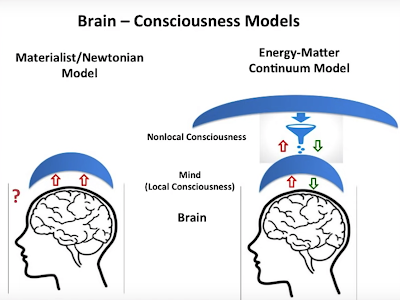
"Models of Consciousness: Determinants of Our Lived Reality
     If you believe in a materialist model that considers consciousness beyond the human waking, dream and sleep states to be abnormal or nonexistent, this will limit your sense of interconnection. But if your model includes a continuum of consciousness within everything, the feeling of connection inherent in this model will naturally generate compassionate action: you understand that what happens to others also happens to you.
     Regardless of which model you accept, a key question is whether you are open to modifying your understanding based on emerging evidence regarding the nature of consciousness? Here is how the astrophysicist Bernard Haisch explains the strong grip of the medical model on modern science and our culture:
'Modern Western science regards consciousness as an epiphenomenon that cannot be anything but a byproduct of the neurology and biochemistry of the brain. While this perspective is viewed within modern science as a fact, it is in reality far stronger than a mere fact: it is a dogma. Facts can be overturned by evidence, whereas dogma is impervious to mere evidence.'
    
Bernard Haisch quoted in: David J. Chalmers. "The Conscious Mind. In Search of a Fundamental Theory."1997, p53

     Consider whether you are open to expanding your existing model of consciousness. As our model of consciousness expands, our experience of connection with everyone and everything around us expands as well. And this, in turn, can lead to an increased capacity for compassion and for actions by which we can heal ourselves and our planet."
     Marjorie
Woollacott PhD neuroscientist https://www.huffpost.com/entry/our-models-of-consciousness-how-they-shape-our-reality_b_59270990e4b0aa7207986b94

     Consider the story of this, now middle-aged, lady who had a near death experience (NDE) at 4 years of age. For much of her life, she only remembered the dark, scary components of her NDE, causing her to fear the dark & falling asleep. This terror was triggered when as an adult she was advised to have a general anesthesia (GA) for an operation. A brief excerpt: 
     “And suddenly it terrified me, with hot & cold shivers going through my body, that in essence it meant giving up control of one’s own consciousness. For about a quarter of an hour I was just going through the feeling of the essence of that loss of control, and tears washed down my face when I had to think about it. That this is the essence of dying, to just let go, to dive down without any ground under your feet. That this is the step out of control, like in death."
     During the GA, she finally remembered all the positive bright, loving, safe, welcoming components of her NDE, and lost her fear of the darkness, sleep, general anesthetic & death. Sometimes, when we lack the courage to accept that which we fear, life overwhelms our childish ego's feeble illusion of control, allowing us finally to see the reality that is here, yet beyond our simplistic materialistic ideas about reality.
    "If we let go of the rational control over our own consciousness, we can get somewhere that forms us and that also forms the universe. I acknowledge that this is, in my opinion, a very important state of mind, a very important process for us all.”

     See Marjorie Woollacott's imho excellent 65min lecture on NDEs, Meditation & Consciousness: https://www.youtube.com/watch?v=BGi39C5Ysk8&list=PLZwmf_5L38HgyTfPnr3hohBbP_-okYhGX&index=1

     We all know that fear triggers our strong survival instinct to control (fight, flight, freeze). However, as the Serenity Prayer (top of the page) suggests, this drive to control is only appropriate & helpful if the situation can be controlled. 
     When we transcend fear - which is often a hard-earned skill, then acceptance, love & connection with a profoundly better, infinitely greater reality opens up.
 

Marjorie Woollacott PhD


Thursday, January 6, 2022

Bouncing into Graceland

     Our origin & true nature is timeless, inexpressible, inconceivable. We can however directly experience our original perfection, ease, oneness, at-homeness, completeness. Romain Rolland named this 'the oceanic feeling' in infancy & early childhood.

     Then around age 2, we start to feel that something's amiss, off, not right, as we start to create & perceive a 'self' (ego) as separate & different from the people & things around us. This model or concept helps us function somewhat independently, and allows each of us to have our own unique, distinct conscious perspective on reality.
     Healthy
, wise, sustainable individuals/societies have quiet egos. Such evolved individuals are productive AND collaborate, for their own benefit AND for the greater good. This is the very essence of a 'civilized individual,' and 'civilization.' The left- and right hemispheres are working in harmony - the right hemisphere being the master; the left hemisphere having an important, but subservient role: https://channelmcgilchrist.com/ 

     However, balance easily devolves to imbalance. When individual egos attempt to dominate ('noisy ego', narcissism, hyper-rationalism, left-hemisphere dominance) at the expense of the common good, such devolution cause the collapse of the Greek & Roman civilizations, AND we're in the same mess now. Those causing the greatest immediate threat to humanity's survival persist doing 'whatever it takes' to become the richest, most powerful, most armed, most defended, most self-centered individuals & nations, though this brings only suffering.

     We can, at least briefly, regain our original sense of intimate connection with the source of all, while retaining our individual conscious capacity to supply our unique perspective & co-creative force through the process of 'awakening.' See: http://www.johnlovas.com/search?q=entheogen
     Most
people have mystical experiences, yet our spiritually-impoverished society tends to consider these as nonsense, or even pathological, so we tend to keep it to ourselves & even suppress these.
     "Spirituality means waking up. Most people, even though they don't know it, are asleep. They’re born asleep, they live asleep, they marry asleep, they breed children in their sleep, they die in their sleep without ever waking up. They never understand the loveliness and the beauty of this thing that we call human existence.”
     Anthony de Mello. “Awareness. The Perils and Opportunities of Reality.” Doubleday, 1992. p5

     "I hope there is no human being who has not had one moment, at least, when they stood in the world, undone by awe & radiance, and the small self vanishes, and you understand the world as immense and yours, and not yours."
     Jane
Hirshfield – The Fullness of Things – On Being with Krista Tippett
https://onbeing.org/programs/jane-hirshfield-the-fullness-of-things/

     "There’s only one happiness and it’s who you are. There’s only one place to find lasting happiness, and that is to know who you are and to be who you are.” Francis Lucille

     “Leo Tolstoy’s Death of Ivan Ilych, originally published in 1886, tells the story of a middle-aged man who is suffering from a terminal, yet undiagnosable, kidney disease. The stress of his illness and impending death has left him in deep personal anguish and despair. Remarkably, after much suffering in his last few days, Ivan has a spontaneous mystical breakthrough:
    
At the end of the third day, two hours before his death…Ivan Ilych fell through and caught sight of the light.... It grew clear to him that what had been oppressing him and would not leave him was all dropping away at once from two sides, from ten sides, from all sides.... ‘How good and how simple!’ he thought. ‘And the pain?’ he asked himself.

     ‘What has become of it? Where are you, pain?’

     He turned his attention to it.

     ‘Yes, here it is. Well, what of it? Let the pain be.’

     ‘And death…where is it?’

     He sought his former accustomed fear of death and did not find it. ‘Where is it? What death?’ There was no fear because there was no death.

     In place of death there was light.

     ‘So that’s what it is!’ he suddenly exclaimed aloud. ‘What joy!’…

     ‘Death is finished,’ he said to himself. ‘It is no more!’ He drew in a breath, stopped in the midst of a sigh, stretched out, and died."
     Bradley Lewis. “Mindfulness, Mysticism, and Narrative Medicine.” J Med Humanit DOI 10.1007/s10912-016-9387-3 Published online: 10 March 2016
.

     “There is a beautiful passage by an anonymous writer of another age that is sometimes read at the end of a funeral service: ‘For life is eternal and love is immortal and death is only an horizon, and an horizon is nothing save the limit of our sight.’
     The passionate longing of the human heart has always been to press beyond the boundaries of the known, to break through the limitations of our understanding. This is perhaps our most fundamental and essential freedom. Now, more than ever, we need to honor that longing and welcome those pioneers who can unveil new horizons, new possibilities of understanding our nature, our potential and our destiny.
”
     Anne
Baring, in the forward to, Betty J. Kovacs, “The Miracle of Death: There is Nothing But Life” Kamlak Center, 2020, pxiii

     “A single force, love, links and gives life to infinite worlds.” Jordano Bruno

     "I began by asking myself, “What do I want out of life?” And the answer was happiness. Investigating further, I went into the moment when I was feeling happiest. I discovered something which to me was startling at the time. It was when I was loving that I was happiest. That happiness equated to my capacity to love rather than to being loved." Lester Levenson

"But the end is reconciliation; the end is redemption;
the end is the creation of the beloved community.
It is this type of spirit and this type of love that can transform opposers into friends. It is this type of understanding goodwill that will transform the deep gloom of the old age
into the exuberant gladness of the new age.
It is this love which will bring about miracles
in the hearts of men
." 

Rev. Martin Luther King, Jr.


Monday, February 15, 2016

Between & Beyond Words


     “ ‘Teach a child the name of a bird,’ writes Jesuit author Anthony DeMello, ‘and she’ll never see that bird again.’
     DeMello means that language, by labeling phenomena, exacts two injuries. First, it obscures uniqueness: the mystery of this bird, this night’s moon. And second, it also fractures the unified field of mystics and physicists. … 
     So we wonder: How to create a family culture with abundant spaces beyond words? How, in such spaces, can we learn from Clea (18-month-old daughter) how to be part of nature’s web, both as individuals and together? … 

     In her book Raising Our Children, Raising Ourselves, family counselor Naomi Aldort encourages parents to refrain from reacting when our kids push our buttons. Buddhist teacher Jonathan Foust has a wonderful acronym for it: WAIT (Why Am I Talking?). 
     I use it a lot. When I’m about to either put a label on a mystery or try to make a situation right, I WAIT. I sink into the sky, a breeze … and also into my inner weather. Something interesting usually happens: The moment aligns. Life doesn’t need my brain.
     After a year of using Aldort’s practice, I realized part of why it’s effective. Instead of anthropocentrically narrowing reality, WAITing allows us to be biocentric: Clea and me both. It allows me to tune in to how attuned she is to surrounding sensory stimulus. She’s noticing a hawk overhead, wings stiff as kites. She’s stopping to pick daisies for Mom. She’s here, now: a plume of smoke, the coarse lick of our kitten Boot’s tongue, a crescent moon. Clea’s in a place of peace. It’s not the nervous, more-is-better place that fuels overconsumption and creates the divide between ourselves and the rest of nature. Clea is nature. Or, rather, she has yet to find out she’s not.”

       William Powers. “Child of Nature.” Lion’s Roar, March 2016.

 
Photo: David A. Lovas

Saturday, October 4, 2014

Suchness Beyond Labels

     "Calling (an) object something, naming it, doesn't make it 'something,' it only makes it what the mind says it is, though something seems to remain in the silence after the words have faded away. (This object) now floats free of the mooring to definition and becomes empty and almost translucent yet somehow silently connected with the rest of the muted world. The silence we now find ourselves in may be a clue to the object's true nature, but let's keep this inquiry alive and see where it takes us."

       Rodney Smith. Awakening. A Paradigm Shift of the Heart. Shambhala, Boston, 2014.


Thursday, January 16, 2014

Key Ingredient - "If I Could Only Bottle It"

     Laziness! Isn't it a common wish to "bottle" a transcendent feeling we might have briefly, maybe once in a lifetime, and that may have occurred only after many years of struggle & failure? Maybe the hope for such a peak experience is the allure of recreational drugs - yet drug-induced experiences apparently only have a magical quality the first time.
     The hard lesson seems to be that life cannot be reduced. We may look for happiness in some tiny fragment of life, yet this very process is misguided & leads to suffering. Our fulfillment is the ENTIRETY of life - the "full catastrophe" - the entire process of living to be embraced as a whole. Likewise, the goal we seek by sitting in meditation IS our state of being in the process of sitting meditation. This same all-embracing wholehearted process is to be lived on & off the cushion. We transform our life, not by a pill or some trick, but ........ BY TRANSFORMING OUR LIFE.
     "It's all hidden in plain sight!"

       http://mindfulnessforeveryone.blogspot.ca/2014/01/475-mindfulness-research-not-so-simple.html

The Dream by Odilon Redon